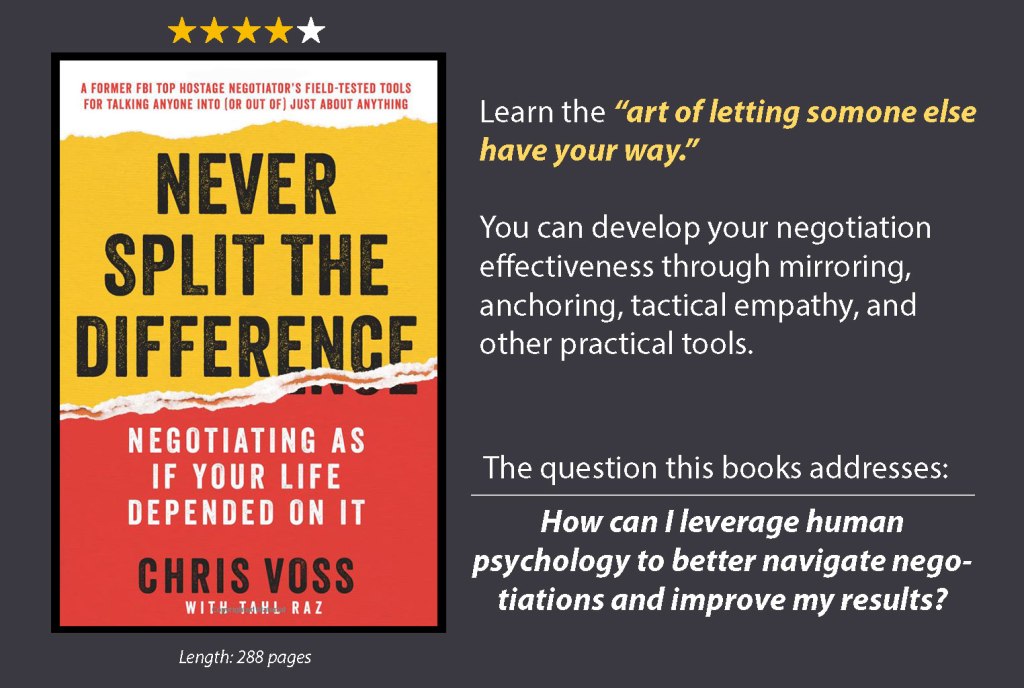
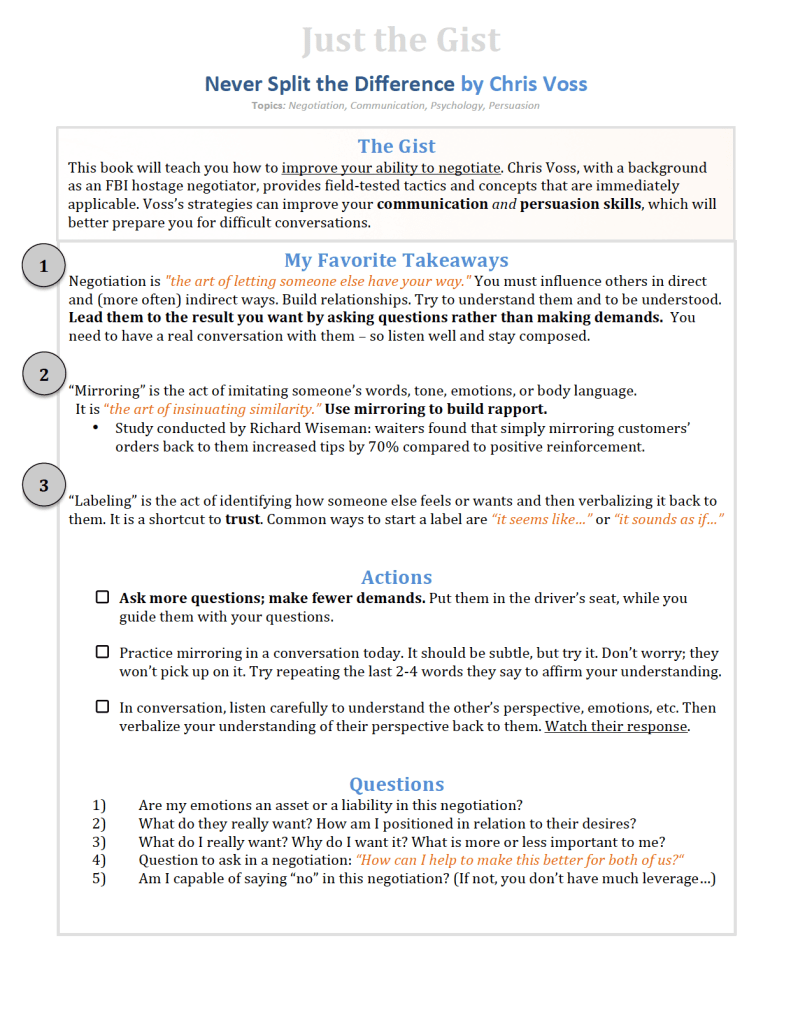
My Full Notes (via Web):
Ch. 1 – The New Rules
3) Use your interlocutor’s name (who you’re negotiating with) & ask open-ended questions
11) Kahneman – “Feeling is a form of thinking.”
- Human thinking systems:
- System 1: (Animalistic) – fast, instinctive, & emotional
- System 2: (Reasoning) – slow, deliberative, & logical.
16) Listening is key. When we listen, others feel heard and understood. When given an opportunity to express themselves verbally, they can clarify their own thoughts & feelings. They may talk themselves through the problem to their (or your) desired conclusion.
18) Get over your aversion to negotiating.
Ch.2 – Be A Mirror
26) People who downplay their importance are often the most important.
26) When in negotiation, let the other person(s) express their perspective first & listen carefully. By allowing them to be heard, you disarm them. It’ll also help them clarify their thoughts.
30) Slow down… The passage of time is key to calming things down.
33) Smiling, even forcefully, helps induce a playful tone and feeling towards others. It’s disarming.
35) Mirroring is essentially imitation of speech, tone, body language, emotion, etc. Use it to induce trust as you induce the feeling of being in sync.
- For speech, you often repeat their last 2-4 words.
- Using a downward inflection of your voice → affirms their statement.
- Using an upward inflection → poses a question to them (i.e. “Tell me more.”)
- Mirroring = “The art of insinuating similarity.”
- Inquisitive mirrors (questions) express: “Please, help me understand.”
36) Study conducted by Richard Wiseman: waiters found that simply mirroring customers’ orders back to them increased tips by 70% compared to positive reinforcement.
44) Confront without being confrontational: Use a downward inflection in your voice.
- Start with “I’m sorry.”
- Mirror them.
- Be silent to let the mirror sink in (~4 seconds)
- Let them respond. Then Repeat
45) Mirroring with an upward inflection is a better way to ask someone “what do you mean?”
- Example:
- Them: “I need more time to finish the project.”
- You: “More time to finish?” (Using an upward inflection in your voice,,,)
Ch.3 – Don’t Feel Their Pain, Label It.
51) Empathy is “the ability to recognize the perspective of a counterpart.” It is not agreeing with them; it is simply about understanding.
- Tactical empathy looks behind someone’s emotions to understand their motives to better influence them moment-to-moment.
54) Labeling requires:
- Identifying someone’s emotion or perspective
- Verbalizing it back to them (indirectly or directly)
- It’s a shortcut to intimacy & trust. Don right, they’ll think: “They get me”
- Scientific studies make clear that labeling an emotion (fear) will decrease its intensity.
56) Common beginnings to labeling statements:
- “It seems like….”
- “It sounds like…”
- “It looks like…”
- Be quiet after a label. Let it sink in.
57) Labeling diffuses the negative & reinforces the positive.
- In a hostile situation, labeling is key.
59) “Look, I’m an asshole” is a good way to say sorry & get them to defend you.
65) Accusation Audit: Name (out loud) all the negative things another may feel towards you first, before they can. This “takes the sting out.”
71) We all want to be understood, so verbalizing your understanding of their perspective is important to establishing and building rapport.
Ch. 4 – Beware “Yes, Master “No”
76) “No” starts the negotiation; it does not end it. Get over your aversion to “no”.
- Change can be scary & “no” provides a feeling of control and protection.
79) In hostage negotiation, listening to them & talking with them was the quickest way to resolve the situation, not demanding their surrender. People need to feel in control.
79) “No” doesn’t always mean no. It can mean:
- “I can’t afford it, I need time to think.”
- “Not right now or under those conditions, etc.”
- Ask:
- What about this doesn’t work for you? OR
- What would you need to make this work?
81) Don’t let the negotiation be about you. Guide your counterpart to discover their goal as their own & (seemingly) on their own.
- When you’re helping someone, make it about him or her, not you. They help themselves; you are simply a guide.
- Helping someone is useless unless they are partially, if not entirely, responsible for the new ideas they have. You want your counterpart to feel in control, like they’re doing a great job and getting the best deal. You want them to feel in control, while you’re really guiding them to what you want.
- Related: Maybe this is one reason why reading changes behavior better than watching videos or being preached at? Reading feels like you are discovering something on your own (although someone is still feeding you the information), whereas video or other media feels more forced.
84) We all want to feel safe & in control, especially in negotiation.
86) Asking “Is now a bad time to talk?” (“No”) is better than asking “Do you have a few minutes to talk?” (“Yes”). With the former, they get to say “no”, and the later they must say “yes.”
87) If you want to make someone else feel in control, ask them for advice on your next move (“what do you think I should do next?”), especially if they are self-conscious and you want to put them at ease.
91) Mark Cuban – “Every ‘No’ gets me closer to a ‘Yes’ “
- Sometimes you have to force a “no” to get them engaged.
- Try mislabeling their perspective or intentions to elicit a response…
92) Elicit an email response by asking: “Have you given up on this project?” (No, I just…)
- It’s direct, but will get their attention.
Ch.5 – “That’s Right”
102) “That’s right” is better than “you’re right” or “yes”.
- Trigger “that’s right” with a summary of their perspective in your words, using silent pauses, mirroring, labeling, etc. to entice a “that’s right” response.
112) You are communicating your understanding of their perspective, building rapport and trust.
- “That’s right” leads to negotiation breakthroughs.
Ch.6 – Bend Their Reality
116) Deadlines are your friend. Understand they are arbitrary and flexible. Don’t let a date force you into a bad deal. “No deal is better than a bad deal.”
- Understand: “When the negotiation is over for one side it’s over for the other too.”
- Make sure they understand there is something to be lost by inaction.
122) “Decision making is governed by emotion.” You can’t decide without emotion.
124) Using the word “fair” is powerful in negotiation. People want to seen moral or “fair.”
- Three ways it’s used:
- “I just want what is fair.” (Implying their offer is not fair & they’re being unfair)
- “We’ve given you a fair offer.”
- “During this discussion, I want you to feel you’re being treated fairly, so if you feel otherwise at any point, let me know we’ll address it.”
128) Anchoring emotions is really important. Start with, “I’ve got a lousy proposal for you!” OR “You’re going to hate this assignment.” They will expect much worse than what you propose.
130) Understand monetary anchors & use them. Don’t be scared or overcome by them.
131) Use a range for negotiations, where the low-end is what you want ($200-$250).
- Ranges make your high anchor seem less unreasonable.
132) Use non-mandatory factors (ex: vacation time, shipping, etc.). Use odd numbers – they feel more permanent, exact, and calculated).
135-138) “How to Negative a Better Salary”
Ch. 7 – Create the Illusion of Control
141) Negotiating is not about beating the other side into submission, but rather guiding them to discover or suggest your preferred outcome, making them do the work.
144) Generally, a change in negotiators signifies they are going to take a harder line.
148) Law of Reciprocity: when somebody gives you something, they expect something in return.
149) Calibrated questions are an indirect way of asking for something without it feeling so.
- How would you like me to proceed? What’s the objective?
- Ask about how and what.
- It is better to lead them to the result with questions than demand them.
- Learn to disagree without being disagreeable.
- Asking “how am I supposed to do that?”is an effective way to do so…
154) List of example how and what questions that make them feel in control.
- What about this is important to you?
- How can I help to make this better for both of us?
- How would you like me to proceed?
- What is it that brought us into this situation?
- How can we solve this problem?
- What’s the objective?
- How am I supposed to do that?
157) Step-by-step negotiation:
- It’s critical you remain calm and rational or else these calibrated questions won’t work.
- Bite your tongue. Pause & think. Let passion dissipate. Never counter attack when insulted.
- If you get harsh, own it and fix it.
Ch. 8 – Guarantee Execution
163) “Yes is nothing without how. Knowing how something will be done is key to execution.”
169) People will always work harder towards something they have ownership of.
- Negotiation – “the art of letting someone else have your way.”
171) Make sure you ensure those “beyond the negotiating table are on board.”
- Deal breakers are more important than dead makers.
172) Negotiating has a lot to deal with qualitative (respect, status, self-esteem, non-financial) factors and often less to deal with quantitatively (money).
- Pay attention to non-verbal cues (body language).
176) 7-38-55 Rule: Communication is:
– 7% what is said
– 38% how it’s said (tone)
– 55% Body language & facial expressions
177) Rule of 3: Get 3 yeses to gain commitment.
- Original yes.
- Summarize & reconfirm.
- Ask how and what question.
178) The Pinocchio Effect – the more words (longer explanation), the more likely they’re lying.
Ch. 9 – Bargain Hard
190) Get over your negative feeling towards financial negotiation. “Clash for cash.”
193) Three Negotiator Types:
- Analyst: data driven, silent, logical
- Accommodator: looks for “win-win”
- Assertive: self-focused, looking to get it done
198) Learn to “take a punch” (i.e. handle an extreme anchor). Deflect. Switch to non-monetary terms. Ask a calibrated question. Stay calm.
202) Anger has to be real if it is to be used (in a controlled manner).
- “I don’t see how that would ever work” is a good response that reveals some anger.
204) If you feel you can’t say “no“, then you’re lost before you start. You have no leverage.
206) Ackerman Bargaining Model: 65% à 86% à 95% à100% + non-monetary item
- Start at 65% of your target price (as your low anchor) & increase from there.
- Your concessions inspire concessions in others.
- Reverse for high anchors…
211) Prepare, prepare, prepare… In negotiation (as in life), you won’t rise to the occasion. You fall to your level of your preparation.
Ch.10 – Find the Black Swan
216) Find the Black Swans (“unknown unknowns”) that change the landscape of the negotiation.
- By definition Black Swans are what we cannot foresee.
- Ask lots of questions to uncover them.
220) Three types of leverage:
- Positive – you control what they want.
- Negative – your ability to make them suffer (threat based)
- Normative – using their norms against them (ex. safety, inclusion, etc.)
224) Know their religion (i.e. what they care about). Ex: politics, values, religion, morals, etc.
227) The Paradox of Power – “the harder we push, the more resistance we face.”
229) People trust those that are similar to them (in their group or tribe).
231) Religion as a reason… “I’d love to accept that, but I have a duty to be responsible with my resources (time & money) & this offer does not satisfy that. “
- Essentially, use some higher (outside you) cause to reject the offer (God, your values or morals, etc.)
232) People are generally not crazy, but rather just not understood. They are:
- Ill-informed or don’t have the facts
- Constrained or have conflicting interests
236) It’s important to get face time (beyond audio) to receive full communication (ex: body language).
237) Pay attention to unguarded moments (before or after a meeting) when their guard is down; these moments often tell us a lot
 Just the Gist