
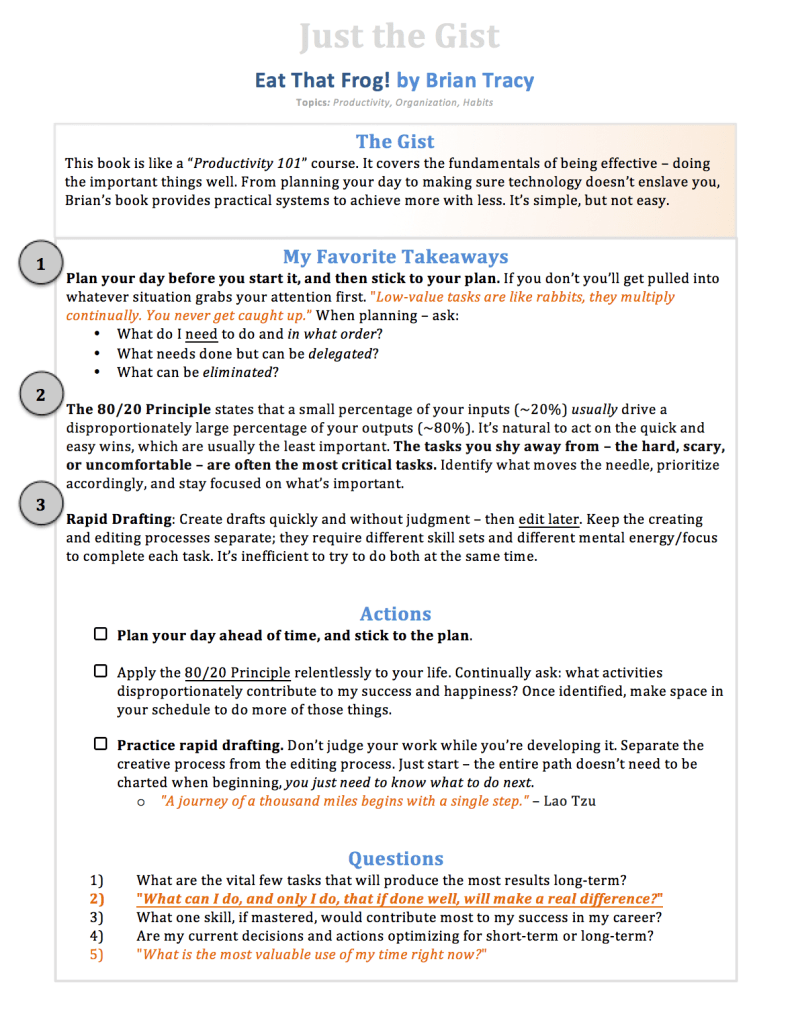
My Full Notes (via Web):
Full Notes
Preface
ix) You’ll never get “caught up”. You’ll always have more to do than time to do it.
- Key: Learn to do the right things. Do only what is essential.
x) Galileo – “You cannot teach a man anything, you can only help him find it within himself.”
xi) Learn from experts and mentors – ask: what factors have contributed to your success?
Introduction
1) Your ability to select your most important task (prioritize) & execute quickly and well is critical.
2) “If the first thing you do each morning is to eat a live frog, you can go through the day with the satisfaction of knowing that that is probably the worst thing that is going to happen to you all day.“
- In other words, start each day by tackling your worst & most important task(s).
- Start immediately and persist until complete. Get after it!
4) Completing tasks makes us feel good. It gives us energy.
Ch.1 – Set the Table
Summary: You need to be clear about what you should be doing if you want to make meaningful progress. Set goals properly and take action immediately.
7) Clarity is key to performance. Anxiety is less about quantity and more about direction and prioritization. The issue isn’t how much you have to do, but what to do next?
8) Think on paper. Write out your goals. Goal setting steps:
- Decide exactly what you want.
- Related: “It doesn’t matter how fast you cut down a tree if you cut down the wrong one.”
- Write it down. Make it tangible.
- Set a deadline (& sub-deadlines as needed).
- Make a list of all tasks necessary to complete to reach your goal. Lay it out visually and sequentially.
- Organize your list into a plan of execution.
- Take action immediately. Do something, anything. Start building momentum right away.
- Resolve to do something every day to move you towards your goal. Never miss a day.
Ch.2 – Plan Every Day in Advance
Summary: Plan your day before you start it. Define yours tasks and prioritize them, ideally the previous night. Every 1-minute of planning you do can save you 10 minutes of execution. Plan for 10 minutes, save 100!
13) Six-Ps Framework: “Proper prior planning prevents poor performance.”
14) Create multiple to-do lists: Master List, Monthly, Weekly, Daily → Always work from a list.
16) 10/90 Rule: The first 10% of planning a project may save you 90% in execution time.
Ch.3 – Apply the 80/20 Rule to Everything
Summary: 20% of inputs often account for 80% of the results. Focus on the vital few factors that matter, not the trivial many. People often want to take care of small requests (trivial) and end up putting off the most important tasks.
- Related: If this concept interests you and you want to read more about it, then I recommend checking out the book The 80/20 Principle by Richard Koch.
19) Humans procrastinate their most critical tasks, as they fear them the most.
20) “Low-value tasks are like rabbits, they multiply continually. You never get caught up.”
Ch.4 – Consider the Consequences
Summary: Success is largely predictable by how well people orient current actions with respect to their future selves (i.e. our ability to delay gratification). Be future oriented. Simulate the scenario in our minds (foresee consequences and benefits). Let the bad ideas die off.
23) Long-term thinking improves short-term decision-making.
26) You can’t do everything (i.e. ever get “caught up”), but you can do the right things.
27) Reflective reminders:
- “What are my highest value activities?”
- “What can I do, and only I do, that if done well, will make a real difference?“
- “What is the most valuable use of my time right now?“
28) “Do first things first, and second things not at all.”
- Related: Priority is a singular word. “Priorities” (plural) doesn’t really make sense. Once you define your number one priority, then by definition nothing else is as deserving of your attention than your most important task. Priorities can change, but that is likely the exception not the rule.
Ch.5 – Practice Creative Procrastination
Summary: Procrastinate the small, unimportant tasks (i.e. the 80% of tasks that account for 20% of the value). Discontinue, or at least de-prioritize, small tasks. Say “no” more. Learn to delegate.
33) Reduce low-value activities (TV, news, social media, YouTube, etc.) and spend more time with family, books, physical training, etc.
Ch.6 – The ABCDE Method
Summary: Rank your tasks (A-E) to determine priorities, tasks to delegate, and what simply won’t get one.
35) ABCDE Method:
- Rating “A” = Very important tasks you must complete. Label as A1, A2, etc.
- Rating “B” = Tasks you should do (B1, B2, etc.)
- Rating “C” = Nice to do (no consequences)
- Rating “D” = Tasks to delegate
- Rating “E” = Eliminate the tasks that don’t (or won’t) get done
Ch.7 – Focus on Key Results Areas
Summary: Develop skills where you are weakest. Establish what areas of your job matter most and structure your focus on developing on those areas. Know why you’re on payroll.
39) Management’s Role (In Business): Planning, Organizing, Staffing, Delegating, Supervising, Measuring, and Reporting
41) List job relevant skill areas. Grade yourself on a scale of 1-10. Work on your weaknesses.
42) Ask your boss:
- “What one skill would contribute most to my success in my career?”
- Related: “What skill do you wish you had developed more quickly in your career?”
Ch.8 – Apply the Law of Three
Summary: Identify the top three tasks that are most important (at work, for family, etc.) and focus most of your efforts here. Cut out the rest if possible. Generally, those three will account for 90% of the value you generate.
50) Quality time at work and quantity at home is what matters.
- Time that you waste at work is time stolen from your family.
50) “Moderation in all things.” – The Greeks
Ch.9 – Prepare Thoroughly Before You Begin
Summary: Prepare a good, clean, and organized workspace; it will help you mentally. Then take immediate action. “Get it 80 percent right and then correct it later.” Don’t edit while you create.
Ch.10 – One Oil Barrel at a Time
Summary: You don’t need to know your entire path of your journey, only your next step. Take your next step now. Go as far as you can see, then you’ll be able to see farther… Just keep doing what you know needs done next.
56) “A journey of a thousand miles begins with a single step.” – Lao Tzu
Ch.11 – Upgrade Your Key Skills
Summary: Improving your skills will make you more confident and competent, and ultimately less likely to procrastinate. “Work harder on yourself than you do your job.” – Jim Rohn
59) Key to Success: “Render more and better service than is expected of you.”
- Go above and beyond what is expected. Surprise people with the value you deliver.
60) Continuous learning and personal development is key for success in any field.
62) Decide to be the very best at what you do.
Ch.12 – Identify Your Key Constraints
Summary: Identify what’s holding you back. Make an effort to remove or alleviate the bottleneck. Most constraints are internal, not external. Most assumptions (also constraints) are often untested, so test them. Find out if they are real or imagined.
Ch.13 – Put the Pressure on Yourself
Summary: Up the stakes… Be, or work towards becoming, the best in your field or group. Create a system that demands excellence from you. Build self-trust and high esteem with yourself. Let the evidence of your excellence build and serve as proof for you and others. Set deadlines and keep them.
69) Self-esteem is simply “the reputation you have with yourself.”
Ch.14 – Motivate Yourself Into Action
Summary: Stay positive and you’ll stay motivated. Develop an attitude of Stoic Optimism (control what you can and choose to have a good attitude).
73) “Don’t share your problems. 80% of people don’t care and 20% are glad you have them.”
74) Difficulty instructs, not obstructs.
- Difficulty is a filter. If you’re struggling, others likely are too. Challenge filters out those incapable or unwilling to persevere. Don’t let it filter you out too, because overcoming difficulty is what separates you from being average.
- Related: “The impediment to action advances action. What stands in the way becomes the way.” – Marcus Aurelius
- This idea from Stoic philosophy is the theme of Ryan Holiday’s bestselling book The Obstacle is the Way. This book is a great read on overcoming challenges.
Ch.15 – Technology Is a Terrible Master
Summary: Use technology; don’t let it use you. Make sure you are in control. We are easily distracted, and technology amplifies this problem. You should silence your phone and email (laptop) notifications to help you to focus. Check your email less. If it’s critical, they’ll call.
79) Just because someone emails you doesn’t mean they deserve a response or your attention, especially not right away.
80) Create silent focus time. Block your calendar. Make space for you to do the essential work.
Ch.16 – Technology Is a Wonderful Servant
Summary: Use technology to improve your productivity. Track tasks, set reminders, block your calendar, auto-filter emails, etc.
80) When doing deep work, use a clean and clear digital workspace. Close other apps.
82) Create a “Read First” inbox that your most important emails get automatically filtered to. For example: emails from your boss, a high-dollar customer, your family, etc.
Ch.17 – Focus Your Attention
Summary: To control the trajectory of your life, learn to master your attention. “All life is the study of attention, where your attention goes, your life follows.”
87) Don’t check your email, phone, or the news first thing in the morning.
- Related: Dopamine is the currency in the brain of drive, desire, and motivation. Use and spend it wisely. If it gets depleted on low value activities, you’ll feel less motivation to do your work or anything else. Especially avoid dopamine-releasing behaviors in the morning (ex: checking social media or the news, eating high fat foods, listening to music, etc.).
- (Source: Andrew Huberman Podcast #39 – HIGHLY RECOMMEND).
88) Work 3 hours towards your top priorities every morning before checking email.
Ch.18 – Slice and Dice the Task
Summary: Break down your big tasks into smaller, more manageable sub-tasks. By completing a piece, you’ll be more motivated to complete the whole thing.
Ch.19 – Create Large Chunks of Time
Summary: Block off time in your day (minimum of 1.5 hours) to focus and get deep into your work. Eliminate distractions (notifications, interruptions, etc.).
Ch.20 – Develop a Sense of Urgency
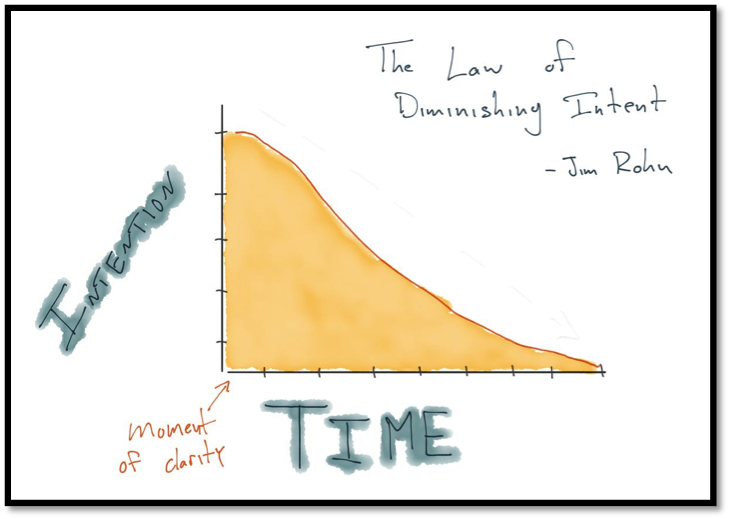
Summary: Be known as someone who does quality work quickly. Act when the feeling is hot, when you’re feeling the motivation. If you don’t, the odds of you acting diminish quickly.
- Related: The Law of Diminishing Intent (Jim Rohn)
- The chance of us acting decreases as time goes on.
100) Productivity feels good. It’s a virtuous cycle. Start small and build momentum.
Ch. 21 – Single Handle Every Task
Summary: Define your #1 priority, and then work on it until it’s complete. By definition, nothing else is more worthy of your time. Stay focused and complete the task.
102) Each time you quit and return to a task, you have to re-familiarize yourself with the topic and overcome the inertia to get going again.
- Related: Practice the “One-Touch Method” – if a task will take you less than 2 minutes to complete, and it actually needs done, just complete it when you first encounter it.
- Don’t put it on a to-do list, or schedule time to do it… Just do it now. Get it over with.You’ll avoid re-reading emails and re-familiarizing yourself with topics you’ve already spent attention on before.
- In other words, you’ll save yourself time & energy in the long run.
103) Discipline – “the ability to make yourself do what you should do, when you should do it, whether you feel like it or not.”
 Just the Gist