
Full Notes
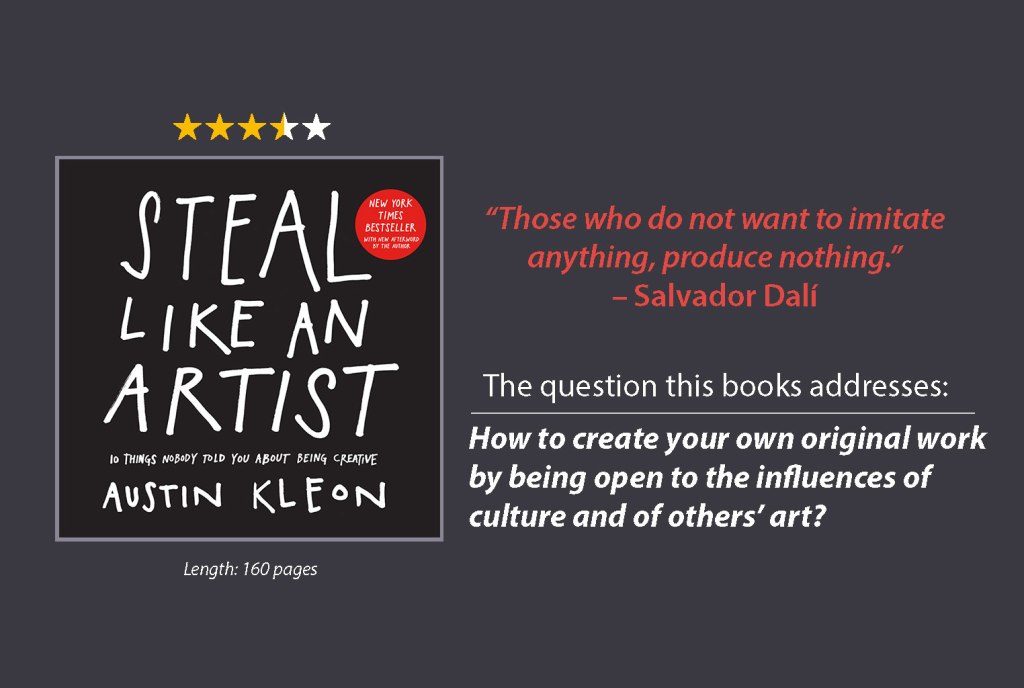
Ch.1 – Steal Like An Artist
Summary: Every artist steals their ideas from others, both consciously and unconsciously. Or rather, we are heavily influenced by others’ work. So immerse yourself in great art – books, music, film, etc. Look for inspiration in the work of others. Pay attention to what energizes you and seek more of it. “All creative work builds on what came before.”
1) When people give you advice, they’re really just talking to themselves in the “past.”
6) “There’s only stuff worth stealing, and stuff that’s not worth stealing.”
7) Most “original” things aren’t original; they just don’t know the source. “Original” works are often the result of “undetected plagiarism”.
- Related: Harry Truman once said that “the only few things new in this world is the history you don’t know.”
8) “Everything that needs to be said has already been said. But, since no one was listening, everything must be said again.” – André Gide
11) Everyone’s perspective is unique. We all have different inputs into our lives, different experiences, books we’ve read, conversations we’ve had, music we’ve heard, etc. Our job is to take all the experiences and influences we’ve have and remix them into something new.
- Remix Like A DJ may have been a more accurate (although less catchy) title for this book. That’s really what’s going on though, we’re recombining many complex ideas into something that seems or feels new, at least new to us.
13) You’re only as good as the people, books, and ideas you surround yourself with.
15) Don’t allocate time to many thinkers at once. Pick one and go deep. Read all they’ve written, and then move on to another. Don’t settle for a shallow understanding.
- Related: The Stoic philosopher Seneca writes about this in his second letter to Lucilius.
- “Be careful, however, lest this reading of many authors and books of every sort may tend to make you discursive and unsteady. You must linger among a limited number of master-thinkers, and digest their works, if you would derive ideas, which shall win firm hold in your mind. Everywhere means nowhere.”
17) You get to choose your mentors through the books you read, videos you watch, podcasts you listen to, etc.). We’re not limited to those close to us (via location or time). Choose wisely.
19) Your education, not necessarily your schooling, is always your responsibility. School is only the beginning of education. Nurture your curiosity. Take your education seriously.
20) Collect books to build an “Anti-Library” (a library, or section of your library, that consists of books you have not yet read). It helps you stay humble and hungry. An anti-library stands as a monument to all that you have yet to learn, which helps keep you motivated to continue learning.
- “There’s magic in being surrounded by books.” à Visit libraries or build one at home…
22) Keep a “swipe” file that includes all the ideas you’ve stolen.
Ch.2 – Don’t Wait Until You Know Who You Are To Be To Get Started
Summary: The act of creating something new is a way to discover oneself. Through imitating our heroes, creating new things, and sharing with the world we continue to refine our likes, dislikes, and how our work (and ourselves) integrates with the world around us.
27) By creating and doing our work, we discover who we are. The work is revealing… It helps us clarify our likes, interests, what keeps us engaged, and what we find meaningful.
- Related: The notorious creative artist Rick Rubin has a similar take on art; the creative process is a process of self-discovery. You uncover parts of yourself that are hard to grasp rationally by following and creating what energizes you and what feels “right.” It’s a process that requires that you bring your abstract ideas into the physical world and reflect on your work. I highly recommend his book The Creative Act: A Way of Being.
30) “You have to start doing the work you want to be doing.” Don’t wait for some future scenario when you’ll have “more time.” You probably won’t; so either accept that you don’t want to make time for your passions/hobbies or start doing them.
33) In the beginning, we learn by copying our heroes (ex: recreate music, speaking, writing, etc.).
- The Beatles started as a cover band.
- Imitate first, and then find your voice. Discovering your voice is an evolutionary process.
- “Those who do not want to imitate anything, produce nothing.” – Salvador Dalí
36) Don’t steal from one person; steal from many. The intermingling of many ideas or styles is what makes you “original.”
- You don’t want to look or sound like your heroes. You want to think and see like them. Study their foundations.
41) Failure to be our heroes is actually good.
- Related: It’s similar to the evolutionary process… Imperfect copies of a DNA (mutations) create variance in species that can be good or bad. Usually the variance isn’t useful, but sometimes the variance produces tremendous results. The bad mutations die off and the good mutations thrive.
Ch.3 – Write the Book You Want to Read
Summary: Simply put – create what you wish already existed. Follow your curiosity and interests. What would the mashup of your interests or talents look like? What do you wish you could read or listen to or watch that doesn’t exist today? à Make that!
48) Thought Experiment: “If all your favorite makers got together and collaborated, what would they make with you leading the crew?”
- Try this to envision what you’d like to create. “Do the work you want to see done”.
- Related: This is similar to “WWJD?” (“what would Jesus do?”). It’s a question people use to guide their actions? Other similar and helpful questions:
- “What would a billionaire do?” –> To guide financial decisions
- “What would a healthy person do?” –> To guide good health choices
- “What would a good father/mother/etc. do?” –> To guide your relationships
Related to this chapter: A scene from The Dead Poets Society (linked here) that has stuck with me… Mr. Keating discusses the purpose of poetry and art in relation to more practical pursuits (engineering, business, etc.). Mr. Keating quotes Walt Whitman’s poem Oh Me! Oh Life! –
“Oh me! Oh life! of the questions of these recurring,
Of the endless trains of the faithless, of cities fill’d with the foolish,
Of myself forever reproaching myself, (for who more foolish than I, and who more faithless?)
Of eyes that vainly crave the light, of the objects mean, of the struggle ever renew’d,
Of the poor results of all, of the plodding and sordid crowds I see around me,
Of the empty and useless years of the rest, with the rest me intertwined,
The question, O me! so sad, recurring—What good amid these, O me, O life?
Answer.
That you are here—that life exists and identity,
That the powerful play goes on, and you may contribute a verse.”
Ch.4 – Use Your Hands
Summary: “Step away from the screen.” Using your hands to create in physical space (not digital) is better for creativity. Create by hand, but edit and publish digitally.
54) Just going through the motions can get our creativity moving. Pick up a guitar or pencil and just get started.
55) TRY THIS: Have a physical desk and a digital workspace. Keep them separate.
- Use the physical desk for idea generation and creative expressions.
- Use the digital workspace to edit, execute, and publish.
Ch.5 – Side Project and Hobbies Are Important
Summary: “Keep all your passions in life.” Let your curiosity thrive. Your side project may one day turn into your life’s work. We produce great results when we do work for it’s own sake.
67) Take time to relax. Take a walk. Monotonous tasks allow our brains time to wander and think.
71) Let your passions “talk” (i.e. mingle). You never know what will come of it.
72) Hobbies are for you, no one else. Do them because you love them, not for money.
- Your passions can feed into your work; they’re energizing.
Ch.6 – Do Good Work and Share It With People
Summary: Sharing your work, online or otherwise, is important. When we share our work with others we demand the best in ourselves to produce our work, and we get feedback and more ideas from others. It increases our chance of luck as well. You never know where lightning will strike.
78) It’s hard to get attention.
- “It’s not that people are mean or cruel, they’re just busy.” – Steven Pressfield
- Enjoy your obscurity while it lasts. Use it to work on what you want. Be free.
79) Accept that your stuff will suck in the beginning. That’s OK. Iterate and improve. Increase your time horizon.
81) Step 1: Wonder about something. Step 2: Invite others to wonder with you.
- Wonder about things others aren’t wondering about
84) If you’re scared of people stealing your ideas, share your dots without connecting them
Ch.7 – Geography Is No Longer Our Master
Summary: The Internet allows you to connect with and learn from people regardless of where you live. Surround yourself with the best minds. Pick great mentors.
90) Create your own intellectual world where to live in now. Make it yours. Design your physical and digital space to suite your needs and likes.
92) Self-imposed captivity is good for your work and your soul.
94) Travel is also important. It gives you new perspectives. Our brains work harder when traveling.
96) Surround yourself with interesting people that don’t do what you do.
Ch.8 – Be Nice (The World Is A Small Town)
Summary: Be forgiving to others. If you write bad things on the Internet about someone, they’re going to find out. Help where you can, and expect nothing in return. Promote others’ work.
- Related: If you give grace to others, you’re more likely to give grace to yourself.
104) “Find the most talented person in the room, and if it’s not you, go stand next to him or her. Hang out with them. Try to be helpful.”
- If you’re the most talented person in the room, you might think about finding another room (to keep challenging yourself).
107) Let your productive actions be the expression of your dissatisfaction. Create in response to your complaints.
108) “The best way to get approval is to not need it.” – Hugh MacLeod
109) How to be helpful to your hero: find a question or problem that one of your heroes has posed. Work to find an answer or solve that problem, and then share it online.
115) Keep a praise file or folder (things you’ve done well or been recognized for). You may need them on dark days when you need a boost.
Ch.9 – Be Boring (It’s the Only Way To Get Work Done)
Summary: Be boring in normal life so you can be exciting in your creativity. It takes energy and predictability to create. You need to have routines in life. A “9-5” career is good as long as you have energy after for your passions in life.
121) Stay out of debt. “(Wealth) is not the money you make, it’s the money you hold onto.”
- Your “9-5” can give you the financial freedom to work on whatever you want creatively.
- Learn and steal from those (their ideas of course) in your day jobs.
124) Establish a routine for your creative work. Stick to it.
- A visual yearly calendar (checking off boxes) can be a helpful motivator.
- Related: Checking off a calendar to track habits is similar to Jerry Seinfeld’s “Don’t Break The Chain” method. He used a calendar (checking off days that he wrote at least one joke) to help him maintain his joke-writing streak. It helped him stay disciplined, as he never wanted to break his good track record.
127) Writing 1 page a day gets you a novel in a year. Small consistent efforts build to big results over time.
130) Gratitude question: “If you ask yourself ‘what’s the best thing that happened today?’ it actually forces a certain kind of cheerful retrospection that pulls up from the recent past things to write about that you wouldn’t otherwise think about.” – Nicholson Baker
Ch.10 – Creativity Is Subtraction
Summary: With the abundance of information and options today, determining what to subtract is often more important than what to add. Limitations and constraints are actually good for creativity. Games without rules aren’t fun. Work within the constraints of your life. Let them lead your work. Just get started with what you have now.
137) There is too much information in modernity. Life is too noisy. You must ignore most of it.
- “Nothing is more paralyzing than the idea of limitless possibilities.”
- You need constraints.
- Dr. Seuss wrote Green Eggs and Ham with only 50 different words.
- What is left out is often what is most interesting.
142) “What Now?
- Take a walk.
- Start your swipe file.
- Go to the library.
- Buy a notebook and use it.
- Get yourself a calendar.
- Start your logbook.
- Give a copy of this book away.
- Start a blog.
- Take a nap. “
147) “Deleted scenes”:
- “Be as generous as you can, but selfish enough to get your work done.”
- “Originality is depth + breadth of sources.”
- “All art is a collaboration.”
- “What do you want your days to look like?”
- “Always be reading. A book is a lens to see the world through.”
 Just the Gist