The Gist
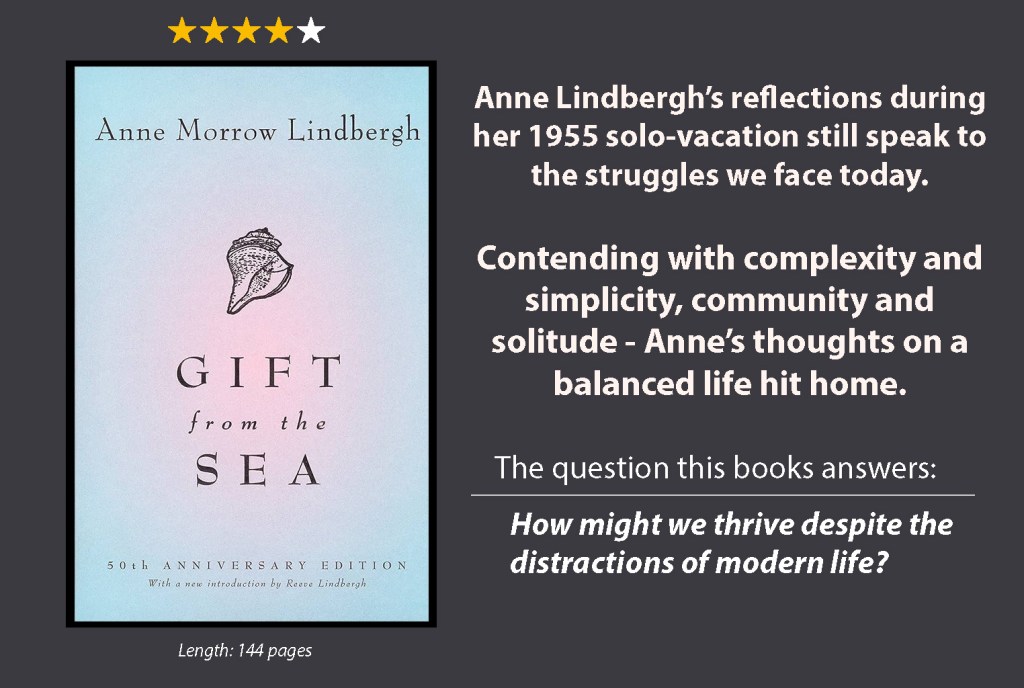
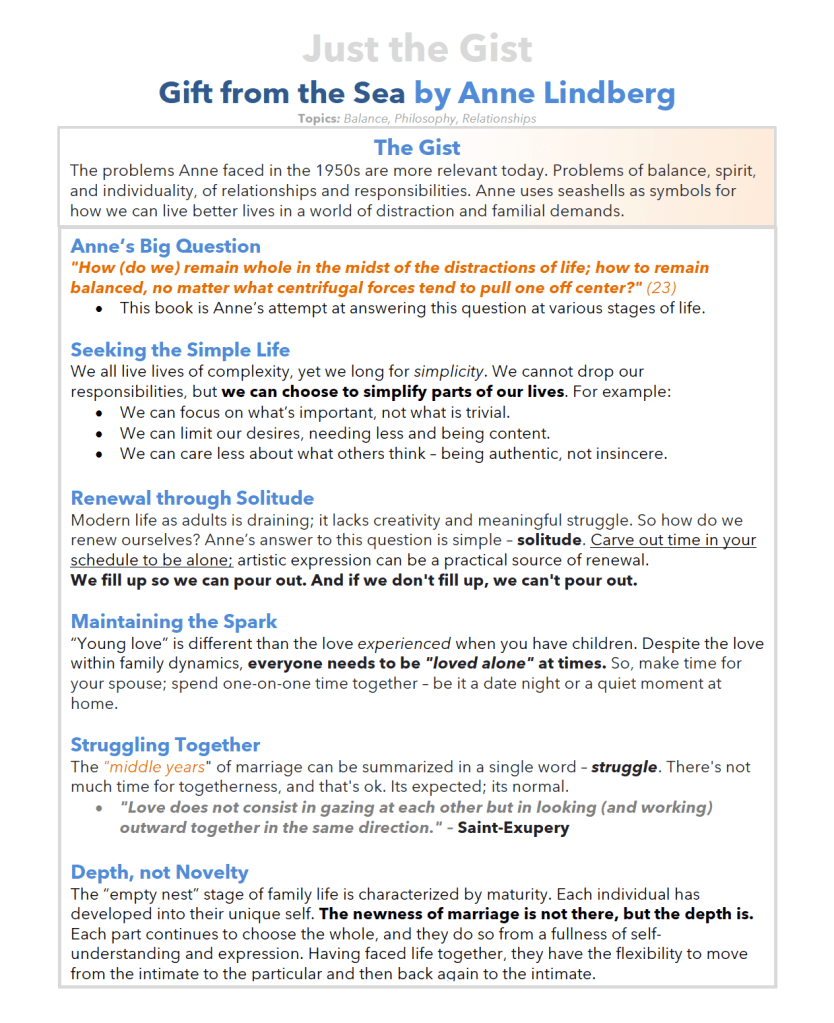
The problems Anne faced in the 1950s are more relevant today. Problems of balance, spirit, and individuality, of relationships and responsibilities. Anne uses seashells as symbols for how we can live better lives in a world of distraction and familial demands.
Introduction
Summary: Anne opens with a question – is everyone really living these “porcelain” perfect lives they outwardly present? No major issues or problems? It seemed that way to Anne, but she couldn’t believe it.
After exploring this question over the years through many conversations with friends and family, what she found was that we are all more like ducks, calm on the surface but paddling like hell underneath to stay afloat. After coming to understand she was more similar to others than she originally thought, she felt open to share her perspective on how she thinks about living a full and balanced life in a chaotic and demanding world.
She wrote this book on a short, solo vacation to an isolated cabin on an island in Florida. Detached from her normal day-to-day life in New York with her husband and their five children, these meditations distill her thoughts on relationships, love, and life.
Ch. 1 – The Beach
Summary: For Anne, the beach is a place to reset. It’s not for work or reading or writing – at least not at first. Not out of compulsion, not until she is ready. The beach refreshes and renews. It warmly welcomed her and coaxed her into a way of being fit for the beach – prone, open, and in no hurry.
That was Anne’s approach; let the beach renew her soul by patiently waiting for her muse (a gift of inspiration) – something. From her view, the Sea delivered the Gift, she just opened it, processed, and repackaged it in her own way so others could also benefit.
Ch. 2 – Channeled Whelk
Summary: Anne reflects on the shell of a Whelk, taken up by a crab perhaps, then abandoned… She wonders if she would like her life to be different. She reflects on her life – her family, her career as a writer, her desires, but foremost – a desire ”to be at peace with myself.” (17) She realizes that she does not want a new life, but rather to simplify the life she has.
Anne comes to realize that “certain environments, certain modes of life, certain rules of conduct are more conducive to inner and outer harmony than others.” (18)
- We’re not controlled by our circumstances; we can impact our state by the way we choose to live our lives – through both the actions we take and the thoughts we think.
She explores different states of being, described as feeling “in grace” or “out of grace.” We can all relate to these states:
- “In grace” – when life has a smoothness to it; things go seamlessly well.
- “Out of grace” – when every act is met with friction and roadblocks; life is a struggle.
Anne reflects on how complicated the life she has chosen is. Appointments, housekeeping, extracurricular activities, friends, family – it’s not simple. Anne longs for simplicity, although she has chosen the multiplicity that comes with (at her time) the modern family.
- “What a circus act we women perform every day.” (20)
Anne realizes that the life she chose is not an easy path. “This is not the life of simplicity but the life of multiplicity. It does not bring grace; it destroys the soul.” (20)
The question that Anne tries to answer: “How to remain whole in the midst of the distractions of life; how to remain balanced, no matter what centrifugal forces tend to pull one off center?” (23)
There is no easy answer. But simplification of life may be a start… we cannot abandon our responsibilities, but we can try to simplify our life by needing less.
- Shed the material needs that society deems normal.
- Care less about the perfect maintenance of our homes.
- Remove the mask you put on for others – be sincere. Have the courage to be yourself.
- “The most exhausting thing in life, I have discovered, is being insincere.”(26)
Anne reflects, as the Stoics and other philosophical thinkers have in the past, that material possessions lead us out of grace. We can be content with little, and Anne’s humble vacation cabin (with its lack of tidiness, decoration, and space) helps her see that – especially in contrast to her home in New York. We need little, and as such, we can learn to be content with little.
Acceptance of a simple outward life is the start… a “clue” about how to revive our soul. The real work is inward, but the outward can affect the inward, so that’s where Anne starts.
Ch. 3 – Moon Shell
Summary: Modern life is draining; it lacks creativity and meaningful struggle. So how do we renew ourselves? Anne’s answer to this question is simple – solitude.
37) “I felt closer to my fellow men too, even in my solitude. For it is not physical solitude that actually separates one from other men, not physical isolation, but spiritual isolation. It is not the desert island nor the stony wilderness that cuts you from the people you love. It is the wilderness in the mind, the desert wastes in the heart through which one wanders lost and a stranger. When on is a stranger to oneself then one is estranged from others too. If one is out of touch with oneself, then one cannot touch others… Only when one is connected to one’s own core is one connected to others, I am beginning to discover. And, for me, the core, the inner spring, can best be refound through solitude.”
Anne reflects, after experiencing the renewed fullness from solitude – is it woman’s fate to “spill herself away?” To give and nourish children, men, and society. Essentially – giving too much… Anne refutes this, saying that women naturally want and enjoy giving, but they want their gifts to be useful and purposeful – not wasted “down the drain.”
With many basic needs provided for, modern life makes it harder to understand our purpose, especially for home-makers. There are not raises or end of year reviews to validate the stay-at-home mom’s (or dad’s) worth… Without feeling needed and valued, distractions fill the void, and distractions are draining.
Solitude is the source of renewal – a little daily, more yearly. All humans need it. And it is not necessarily an issue of economics. Wealthy woman still do not make the time for solitude even though they have the means to. It’s an issue of intention, habit, expectation, and will. But the norm is that there is no time for isolation… Alone time helps us find our inner stillness from which all our energetic expression in life comes from.
- “I feel we are all islands in a common sea. We are all, in the last analysis, alone.” (35)
The freedoms gained from the Feminist movement were only act-one is a two-act story.
- “We are aware of our hunger and needs, but still ignorant of what will satisfy them. With our garnered free-time, we are more apt to drain our creative springs than to refill them.” (45) We have yet to figure out how to wisely use the freedoms we have gained.
Pre-modern society must have been more nourishing to the soul; it was more creative. Baking bread, teaching children, sewing clothes… these are more soul filling than shopping or being a chauffeur. Modern life lacks the creativity that fills us. The answer is not to go back though; the time modernity saves us is good, we just need to adjust.
Turning inwardly daily can help. Creative expression through prayer, meditation, art, or music can also help. Do some solo activity to feed your soul and heart. We fill up so we can pour out. And if we don’t fill up, we can’t pour out. So the moon shell is a reminder of solitude, and how important it is for us all – especially in the modern world.
Ch. 4 – Double Sunrise
Summary: Anne discusses the contrast between “new love” and experienced love.
- New love is fresh, intriguing, and energizing, but it fades.
- We take on responsibilities for our increasingly complex life. This makes things challenging. We have less time to ourselves and for our spouse (especially with kids).
Couples need alone time. They need to experience moments together (like a dinner out) that are just between them, not with family. Everyone needs to be “loved alone” at times. This applies to your kids as well. One-on-one relationships are very different than family dynamics.
So, make time for dates. Know that relationships exist in moments; take advantage of them. Be together, even within the craziness of life. Learn to love again in the present moment with your partner.
Ch. 5 – Oyster Bed
Summary: The oyster is a good representation of the “middle years” of marriage – struggle. There’s not much time for togetherness, and that’s ok. Functionality is what’s needed.
- Saint-Exupery’s line captures this stage well – “Love does not consist in gazing at each other but in looking (and working) outward together in the same direction.” (73)
Love starts in romance and moves to habit through the shared experience of life together – both conscious and unconscious.
“I am very fond of the oyster shell. It is humble and awkward and ugly. Its form is not primarily beautiful, but functional.” (75)
The middle years of marriage eventually fade. The kids go to school or marry. They leave and then what? What stage comes next? The young love stage cannot be attained again, there is too much lived experience, history, and understanding to go back… maybe post-middle age is a period of shellnessless, needing not material possessions or status (Ego). Shedding the external to gain the internal – completeness of self, contentment with existence. We simply outlive some of our desires.
The morning of life is busy, rushed. The afternoon is under appreciated. Finally, there is space and time for the physical, spiritual, or cultural. Most people experience the space of middle age and don’t know how to cope. They have affairs, work, or drink too much, or simply drift into angst. The time must be cultivated and used to grow into this next phase of life. We’ve earned it.
Ch. 6 – Argonaut
Summary: The next stage seems to be one of maturity, of complete individuals. The argonaut shell is a sign of “fair weather and favorable winds” in folklore.
- This is where each individual has come “of age” (developed as an individual and knows how to stand alone.) It’s two individuals who have become fully themselves, reconvening with the space and time that “middle age” permits (now that the kids are out of the house.) Or at least we now have the space to grow as individuals.
- We must all become “world to oneself for another’s sake.” We learn who we are fully so we can best operate in the world for the benefit of ourselves and others.
This stage is unique because we have had years of slow growth and development through difficulty and happiness that only years of experience can give us. We’ve evolved.
88) We “must learn to not depend on another, note to feel (we) must prove (our) strength by competing with another.”
90) “Even between the closest human beings, infinite distance continues to exist.” And that’s ok. As we grow as individuals, we diverge. But like a tree, branches may separate but they are still part of the same tree. And there is a clarity, freedom, and appreciation in knowing that your partner is free from control and impossible to fully understand. They are beautiful, wild, and free, but they continue to choose the relationship.
- This relationship of whole individuals coming together may be too idealistic… but “theory precedes exploration.”
91) “One perfect day can give clues for a more perfect life.” Even if it’s unattainable…
…
Anne describes her ideal day: She’s with her spouse. They take a morning swim in the ocean, a walk, and back to the house for breakfast (hot coffee). They do some minor chores and then they separately dive into deep work until lunch. Lunch leads into an afternoon swim, then another long beach walk until dusk. Back to the cabin for drinks, dinner, and long conversations of depth, not small talk. Then back out to the beach to watch the stars, and finally bedtime.
What keeps us from our ideal relationship? Fear? Is fear the opposite of love? Self-conscious fear, to be specific. We cannot love another and yet be afraid in the relationship. The dance of true love is “when each partner loves so completely that he has forgotten to ask himself whether or not he is loved in return.”
The Argonaut stage is one of wholeness and flexibility of mind: “the double-sunrise stage was only intimate and personal (young love). The oyster bed was caught in the particular and the functional. But the Argonaut, should they not be able to swing from the intimate and the particular and the functional out into the abstract and the universal, and then back to the personal again?”
100) “When you love someone, you do not love them all the time, in exactly the same way, from moment to moment. It is an impossibility. It is even a lie to pretend to. We have so little faith in the ebb and flow of life, of love, of relationships. We leap at the flow of the tide and resist in terror it’s ebb. We are afraid it will never return. We insist in permanency, on duration, on continuity… Security in a relationship lies neither in looking back to what it was in nostalgia, nor forward to what it might be in dread or anticipation, but living in the present relationship and accepting it as it is now.”
102) Reflecting on the periods of life she’s meditated on, Anne concludes that each period of life, of our relationship is valid and wonderful in its own way.
Ch. 7 – A Few Shells
Summary: Anne reflects on the need for space in life to truly appreciate it. Space allows Anne to be more present and helps her recognize the beauty and awe in simple things, like cooking and talking to strangers.
Selection is more important than collection. One perfect shell is better than five good ones.
- It’s hard to appreciate the uniqueness of life when we have such abundance.
- “The acquisitive instinct is incompatible with true appreciation of beauty.” (106)
We need space to recognize and appreciate beauty. And this space is infrequent in day-to-day life. There is simply too much that pulls on our attention – obligations, people, and things. They are important obligations, people, and things, but that doesn’t discount the fact that they crowd our lives. It is not only the trivial that crowds out the space we need.
- “A note in music gains significance from the silences on either side.” (107)
For Anne, the reduction in familial burdens on vacation were met with increased physical burdens, but these physical burdens were refreshing. To bake bread, bath in the water, “burry garbage”… all these things were refreshing as they brought her balance.
Anne also reflects on serendipitously meeting people on the island – people she would have never met in her suburban life. She meets them and finds them intriguing– an eye-opening expression of humanity and reality. We normally choose to be around what’s familiar, but the island gave her the strange, which she needed.
Reflecting on her return to normal life – “The multiplicity of the world will crowd in on me again with its false sense of values. Values weighted in quantity, not quality; in speed, not stillness; in noise, not silence; in words, not in thoughts; in acquisitiveness, not beaty.” (111)
The island helped Anne see through new eyes – “island eyes.” Anne recognized that the lessons of the sea must be applied when she returns to her normal life, and that these lessons would likely be easy to forget as her awareness and perspective from vacation fades with time. “The shells will remind me; they must be my island eyes.” (112)
Ch. 8 – The Beach at My Back
Summary: At the end of her trip, Anne reflects on her whole experience and thinks about some big questions of her “modern” and globally connected world (in 1955). Questions like:
- Do we really have the bandwidth to care for all the problems of the outer world, or do we do so at the neglect of our inner circle (family, local community)? We feel the vibrations of “eruptions” elsewhere, so we’re not ignorant to their existence. Our hearts can bear more than our bodies can bear in action or minds. “Modern communication loads us with more problems than the human frame can carry. My life cannot implement in action the demands of all the people to whom my heart responds.” (If this was true for Anne in 1955, recognize it is more true today…)
- Why are we so future and past focused? In America, things are as good as anywhere on the planet, and no one seems to stop and appreciate life. Is it because the present is complex or scary, so we focus on a future that makes no promise to be better than today? A dream of the future can simplify things, but it is an escape from the present.
- Why has concern for the individual been given over to the masses – in both care, thought, and action? We’re all “islands”, not monolithic.
Anne’s answer seems to be to return to the inner circle – localism.
- Being present now.
- Tending to everyone as the unique and amazing individuals they are.
- Solving the problems most close to home first, before trying to solve the world’s problems. If we don’t, our relationships suffer. “This is the basic substance of life.” (119)
The local is what builds the global. Neglect the local and you lose the global.
117) “Because we cannot solve our own problems right here at home, we talk about problems out there in the world. … Can one solve world problems when one is unable to solve one’s own? Where have we arrived in this process? Have we been successful, working at the periphery of the circle and not at the center?”
118) “Perhaps we never appreciate the here and now until it is challenged, as it is beginning to be today even in America.”
Bonus – Gift from the Sea Re-Opened
20 Years after Gift from the Sea was published (1975), Anne reviews both its contents and its popularity. She states that after the Oyster Shell period of her life (intense familial responsibilities), the Argonaut did not come directly. It was more of an “abandoned shell” period. It was very lonely, and she again had to rediscover herself to make it to the Argonaut stage. The inner work done earlier in life, to cultivate hobbies and internal peace, becomes critical at this stage.
She was astounded by how many women found her words relatable, as she was just trying to work out her own problems. She’s also confused by its continued popularity, as much has changed in the 20 years since it was published. To Anne, modern women seemed to be living more courageous and aware lives. Anne attributes the social movements (Civil Rights, Environmental, etc.) to “expanding consciousness,” in society. We’ve become more conscious of each of us as individual humans, regardless of race, sex, class, or creed. That’s what characterizes progress to Anne in her moment – expanding consciousness (awareness) of our reality.
She ends by, again, hailing the modern women of the day, praising them for their courage and the progress they continue to make. Progress in conversing too, not just in private, but in public. She recognizes that men are listening and trying to help be part of the progress rather than a hinderance. Lastly, she sees that the complexities of tomorrow aren’t possible by men or women alone, but by both working side-by-side as equals.
129) “Growth in awareness has always been painful.” Think back to your high school or college days for proof… You’re now aware of how cringe you may have been back then. And in a decade from now, you may again have the same experience looking back on your life now.
 Just the Gist