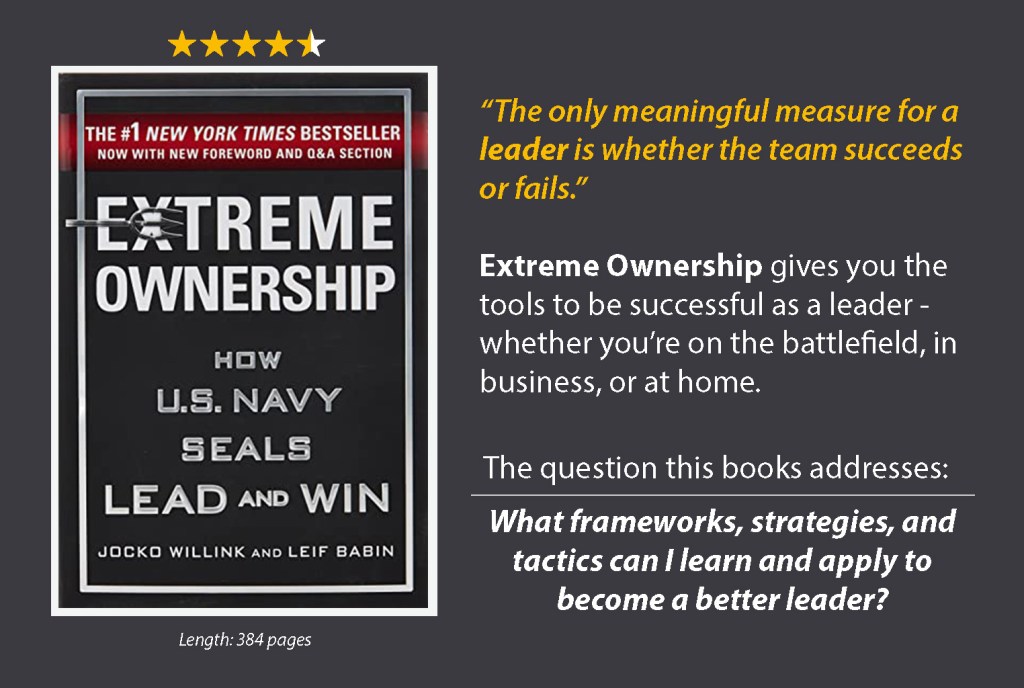

The Gist
Many leadership principles are simple, but not easy. Jocko Willink and Leif Babin provide battle tested leadership strategies and tactics that also work in business and at home. The authors use stories from war and business to demonstrate how these ideas apply practically to day-to-day life. For all leaders looking to improve, this book is essential.
Highlights
- High-agency leaders must own everything in their world.
- There are no bad teams, only bad leaders.
- The leader must be a ”true believer” in the mission.
- An unchecked Ego can sabotage the mission.
- Leaders must cultivate a culture of genuine teamwork.
- Keep it simple – seriously; risk loves complexity.
- Amidst chaos – leaders must pause, assess, decide, and execute.
- Leaders should empower their team members to make decisions.
- A good plan includes the WHAT, WHY, HOW, and WHAT IF (?).
- It is the leader’s job to proactively keep the chain of command informed.
- Leaders must be decisive, despite lacking perfect information.
- Counterintuitively – we earn more freedom through disciplined action.
Full Notes
Introduction
8) Leaders must be humble and courageous enough to admit their mistakes and move past them.
“The only meaningful measure of a leader is whether the team succeeds or fails.”
pg. 8
11) Leadership is the single greatest variable that determines a team’s success.
14) Extreme Ownership: leaders own everything in their world. They look first at how they may have contributed to failure before casting blame towards others.
Part I: Winning the War Within
Ch. 1 – Extreme Ownership
Summary: During a mission Jocko was leading on deployment in Iraq, his team experienced a fatal “blue-on-blue” incident (friendly fire).
- Although many individuals made mistakes, Jocko was the leader, so he took ownership (in this case, blame) for what happened.
- Jocko believes he would have been fired if he had tried to blame others involved.
- Because Jocko took ownership for this extreme scenario, his team was able to learn from their mistakes and correct procedural weak points in their operations to avoid future disasters.
MAIN PRINCIPLE: The leader must own everything in their world. (30)
- Taking Extreme Ownership of failure requires both humility and courage.
- For example, if someone on your team isn’t performing as expected, it is up to the leader to either:
- Provide better training and/or support.
- Clarify expectations.
- Remove them from your team.
- Failure to follow through on this step is ultimately a disservice to your team and all extensions from your team (organization, customers, etc.).
- Accept failures when they occur and give credit to your team when you succeed.
- The leader is responsible for team performance, so it if the team fails, the leader is responsible for the failure.
- Set the example you want your team to follow. Be the standard.
• • •
25) Mistakes are asymmetrical. A lifetime of good can be erased by a single act.
- Trust broken by a lie; love destroyed by cheating; health overcome by recklessness.
34) It is the leader’s responsibility to get others to listen, support, and execute plans.
- You don’t force people to follow orders; you lead them execute the mission.
35) Question to reflect on: “How can you best get your team to most effectively execute the plan in order to accomplish the mission/goal/task?”
37) The best Navy Seal leaders accepted responsibility and sought guidance on how to improve. Put your Ego aside; performance over Ego – always.
Ch. 2 – No Bad Teams, Only Bad Leaders
Summary: During a drill session where Seal teams were competing to complete a water course on boats, two teams stood out:
- Team 2 was consistently winning, and Team 6 was consistently losing.
- Eventually, the leaders of those teams switched and with that change, their performances changed with it.
- Team 6 was suddenly performing well, and Team 2 started struggling.
- “Team 6 did dramatically better once they had a good leader.”
MAIN PRINCIPLE: There are no bad teams, only bad leaders. (54)
- The leader’s attitude sets the tone for the whole team. The leader is responsible for setting standards and upholding them.
- If the whole team is underperforming, look to the leader first.
- Fix the leader, fix the team.
“When it comes to standards, as a leader, it’s not what you preach, it’s what you tolerate.”
pg. 54
• • •
54) Regarding team conduct and performance, what matters is what you accept, not what the policy says.
- You must hold others and yourself accountable to the standard.
- Unenforced standards are meaningless.
- With bad performance in your team, either fix it or get rid of them. Don’t let them set a new (lower) bar of bad performance.
58) Those with a victim mentality often make excuses, pushing blame elsewhere.
- “Tortured Genius” – Someone that sees problems with everyone and everything else, but none within themselves.
Ch. 3 – Believe
Summary: On deployment, Jocko and Leif were ordered by their leadership to fight alongside poorly trained Iraqi soldiers. At first, they didn’t understand…
- Jocko’s immediate response was “hell no!” as he had safety concerns for his team.
- He knew that he needed to voice his genuine concerns and ask well-intentioned questions to his superiors to understand the WHY behind the direction being given.
- After further inquiry, he discovered the order to fight alongside the Iraqi soldiers was necessary to train and strengthen the Iraqi armed forces. But again, WHY?
- The directive was a long-term strategy so the Iraqi gov’t could become more competent. This would provide stability in the region without needing U.S. Forces.
- The order was an exit strategy, it just wasn’t instantly clear at first.
- Jocko sought clarity until he understood, which enabled him to communicate the plan and the WHY behind the plan to his team.
MAIN PRINCIPLE: The leader must be a true believer in the mission. (76)
- If the leader has concerns, it is their responsibility to seek a better understanding.
- If a leader has doubts, their team will too.
- To sell something, you need to passionately believe in it.
- The why behind the what must be explained, and genuine belief in what you are selling helps when explaining both.
- Related: “Sales is a transfer of conviction from you to your customer through a bridge of trust.” – Alex Hormozi
• • •
79) In business, corporate leadership generally wants good things for the company, so when something doesn’t make sense, you may be missing some important context/intent.
- Be humble. Everyone has different perspectives, because we all have access to different information and experiences.
- If you were in their shoes (with their lived experience, information available to you, and incentives), you may make the same choices.
- If you need clarity, ask for clarity.
- Ask questions from genuine interest and a desire to understand. (84)
- Related: “Complaining is not a strategy. You must work with the world as you find it, not as you would have it be.” – Jeff Bezos
85) It takes courage to say “I don’t understand” or to question leadership, but it is the necessary responsibility of junior leaders.
Ch. 4 – Check the Ego
Summary: Jocko tells a story about a new platoon and their commander who joined them in Ramadi. The platoon was arrogant, prideful, and driven by Ego.
- The platoon thought they were better than the other U.S. Armed Forces in Ramadi, and it had dangerous consequences.
- They refused to take advice from forces that had been fighting in Ramadi for weeks or months. Their Egos wouldn’t let them learn from others.
- They refused to disclose their mission plans to other forces conducting operations in the area. This increased the chance of blue-on-blue situations.
- Given their refusal to work with others, they were quickly pulled out of Ramadi.
- They had to sit on the sidelines while the battle was left to be fought by those that were able to subordinate their Egos to support of the overall mission.
MAIN PRINCIPLE: An unchecked Ego can sabotage the mission. (100)
- The Ego is the opposite of humility; it seeks validation, not truth.
- It clouds judgment, refuses to learn, and makes you complacent.
• • •
“It is impossible for a man to learn what he thinks he already knows.”
Epictetus
104) To take Extreme Ownership requires you to control your Ego.
- If a someone on your team makes a mistake, check your Ego, and reflect on how you yourself contributed to the mistake.
- Did you provide enough training?
- Was your training engaging or could it have been improved?
- Did you set clear expectations?
- Have you created a culture where people aren’t held accountable for mistakes?
- Accept the mistake, learn from it, and improve so it doesn’t happen again.
Part II: The Laws of Combat
Ch. 5 – Cover & Move
Summary: On a mission to clear and seize a portion of Ramadi, Leif and his team worked well together, but they failed to utilize neighboring armed forces to provide support when they were in danger.
- They only used “Cover & Move” tactics within their team, not with other teams nearby.
- The mission could have been executed more safely had they expanded their collaboration to other U.S. forces operating in the area.
MAIN PRINCIPLE: Leaders must cultivate a culture of genuine teamwork. (121)
- The focus must remain on how to best accomplish the mission – together. This may require you to take more ownership for the relationship, lend additional support, or “bury the hatchet” on past issues.
“It’s amazing what you accomplish when you don’t care who gets the credit.”
President Harry Truman
• • •
117) Sometimes the best decision is the least bad one.
124) “The enemy is not in here.” The enemy (your competition) is outside the company.
125) Working with a group outside of your chain of command?
- Work with them to clarify needs and expectations for both parties.
- Keep the mission at top of mind; drop your Ego.
- Build the relationship. This takes more work, but its effective.
- Try to understand their challenges, constraints, and motivations.
- See what you can do to help them (and actually help them).
Ch. 6 – Simple
Summary: Jocko tells a story about a “presence patrol” mission; the intent of the patrol was to show a U.S. presence in a hostile part of Ramadi to demonstrate strength.
- The lead for the mission had not yet conducted an operation in Ramadi. Due to his lack of experience, he was overconfident. His overconfidence led him to plan an initial route for the patrol that was too long and overly complex.
- The initial route would have taken them through three different battle spaces (controlled by different U.S. forces) and through IED filled streets.
- Jocko, knowing the inherit complexities and dangers associated with the plan, influenced the leader to simplify the mission; he reluctantly agreed.
- Once the patrol began, it only took twelve minutes until they were engaged by enemy fighters, rendering two soldiers wounded, one of which would succumb to their injuries. They needed backup and evacuation.
- Jocko coordinated support, and they were able to evacuate the team without any other casualties.
- Even with the simplified plan, it arguably failed. Had it been more complicated, backup wouldn’t have been feasible, and the losses would have been catastrophic.
MAIN PRINCIPLE: Keep it simple – seriously. (140)
- If you can’t explain your plan logically, sequentially, and in plain terms, it may be too complex. Consider simplifying.
- Be careful – if you oversimplify things, you risk losing important information.
- The more complex your plan, the more risk you face. Risk loves complexity.
“Everything should be made a simple as possible, but not simpler.”
Albert Einstein
• • •
140) Plans must be simple so they can be communicated clearly to others.
- If others don’t understand your plan, that’s on you.
- It doesn’t matter how well you think you explained something. Their understanding (or lack of) is a measure of how well you communicated.
- If you didn’t explain it well enough, then maybe the plan is too complicated?
143) Remember simplicity when crafting policies, workflows, or procedures. Sometimes you can be so close to a problem that you become blind to its complexity.
- Those who must follow the process need to understand it quickly, not after hours of review and deliberation over the material.
“As a leader, it doesn’t matter how well you feel you have presented information or communicated an order, plan, tactic, or strategy. If your team doesn’t get it, you have not kept things simple and you have failed.”
pg. 140
144) People need to understand the reasons why they are rewarded or punished for them to change behavior.
- The less time between the behavior and the feedback, the better.
- Delayed feedback is less impactful.
145) Why is simplicity so important? “The enemy gets a vote.”
- Things will go wrong, so don’t expect to execute your plan without any issues.
- Related: One of Murphy’s Laws states: “Anything that can go wrong will go wrong, and at the worst possible time.”
- “The enemy gets a vote.” –> “Murphy gets a vote.”
- Related: “Everyone has a plan until they get punched in the face.” – Mike Tyson
- Related: Gall’s Law states that all complex systems that work evolve from simpler systems that worked.
- If you need to construct a complicated system that works, build a small working system first and gradually enhance or scale it.
- Starting with a complex system and then scaling it is destined to fail.
Ch. 7 – Prioritize & Execute
Summary: On a mission deep into hostile territory in Ramadi, Leif and his team found themselves in chaotic and dangerous situation.
- While attempting to exit a building where they had taken heavy fire all day, they were met with chaos in the form of:
- IEDs planted outside the only normal exit from the building.
- An alternative rooftop escape route where they were vulnerable to attack.
- An injured soldier who had fallen through the roof to the street below.
- Despite the chaos – Leif composed himself, thought clearly, and executed effectively.
MAIN PRINCIPLE: Amidst chaos – leaders must pause, assess, decide, and execute. (161)
- Helpful Mantra: “Relax, look around, make a call.”
- Identify the highest priority task, then execute. Once complete, repeat.
- Not deciding is a decision.
- Contingency planning can help you manage when challenges inevitably arise.
• • •
Related: The OODA Loop is a mental acronym often used in the U.S. military as a reminder to prioritize and execute.
- Observe – Gather the facts and data of the situation.
- Orient – Given your observations, assess your options – accounting for risk/benefits.
- Decide – Choose your best option.
- Act – Execute the plan that was decided, timely. –> (Repeat)

164) Ensure your team understands the priority; reiterate it often.
Ch. 8 – Decentralized Command
Summary: During a mission involving hundreds of U.S. Forces, Jocko was able to help avoid a potentially deadly blue-on-blue scenario by using Decentralized Command.
- Jocko empowered his junior leaders to make decisions on the battlefield.
- They had been trained and proven themselves trustworthy.
- Frankly – it was necessary. Jocko couldn’t make all the decisions that needed making while still focusing on his role of managing the overall operation.
- Army Forces misidentified a building number, which caused them to think the armed men spotted on the rooftop were enemy fighters, when in fact, they were Navy Seals.
- Trusting his team – Jocko was able to stay high-level, saw the potential error, and intervened. His intervention undoubtably stopped a deadly friendly fire incident.
MAIN PRINCIPLE: Senior leaders should empower junior leaders to make decisions.
- Junior leaders operate under the Commander’s Intent, which is a combination of:
- WHAT they want to achieve
- WHY they want to achieve it
- HOW they intend to operate while striving to achieve it
- When junior leaders know their boss’s “Commander’s Intent”, they can make decisions that more closely reflect the decision that their boss would make.
- Since issues emerge often without time to check in with your boss, the Commander’s Intent helps provide guidance.
- Junior leaders should know the limits of their decision-making authority.
- If they’re not sure, they should clarify with their boss.
- They should be proactive, not reactive.
- GOOD: “Here’s my plan…”
- BAD: “What should I do?”
• • •
“There are leaders who try to take on too much themselves. When this occurs, operations can quickly dissolve into chaos.“
pg. 184
185) Leaders need to be fluid – sometimes “in the weeds” and other times focused on the big picture.
188) The ideal team size is roughly 5-6, give-or-take.
189) Decentralized Command can make relaying information up and down the chain of difficult; this is why simple communication is critical.
190) It’s wise to delegate some responsibilities to junior leaders.
- It depends on how long of a time horizon you are working on.
- Short-Sighted:
- Controlling everything yourself may work, but it robs your team of the experience needed to grow.
- Plus, if it is a complex and changing situation, your team won’t be equipped to respond quickly since you’re a bottleneck.
- Far-Sighted:
- By delegating some decision-making responsibilities to your team, everything may not be perfect, but they will learn and grow.
- Since they have more control over their work, they will take more ownership, often becoming more invested in the execution and outcome.
- With competent and empowered team members making decisions, your team can respond more quickly to the demands of the job.
- Short-Sighted:
- Delegate strategically to limit catastrophic consequences while reaping the benefits.
“As a leader, it takes strength to let go… Situations will sometimes require that the boss walk away from a problem and let junior leaders solve it, even if the boss knows he might solve it more efficiently.“
pg. 190
Part III: Sustaining Victory
Ch. 9 – Plan
Summary: During a hostage rescue mission, Leif and his team planned the mission, accounting for likely risks and creating contingency plans to accordingly.
- Just before leaving for the missions, they received a new intelligence report: “there are IEDs buried in the yard and bunkered machine gun positions in the house.”
- Because they had already planned for these contingencies, they were able to confidently move forward without wasting precious time.
- They executed the mission flawlessly, rescuing the hostage without firing a shot.
- The intelligence report was incorrect; regardless, they were prepared.
MAIN PRINCIPLE: A good plan includes the WHAT, WHY, HOW, and WHAT IF (?). (204)
- The Commander’s Intent is the most important aspect as it guides decision making during execution.
- Delegate specific planning tasks to team members.
- Giving ownership promotes engagement and ownership.
- Plan for the worst (as best as possible) but accept that there are some risks that cannot be accounted for or mitigated.
• • •
205) The team should understand:
- The specific mission (What we’re doing: the start and end state)
- The strategic mission (Why we’re doing it)
- The Commander’s Intent
- Their individual roles within the plan
- Mission contingencies to account for reasonable risks
205) The test of a plan is whether or not everyone clearly understands it.
- Your plan must be understood by the most junior team member.
“Those who will not risk cannot win.”
pg. 206
206) Seals conduct “post-operational debriefs” to learn from each mission. They review:
- What went right?
- What went wrong?
- What can we adjust in the future (strategy and tactics) to be more effective next time?
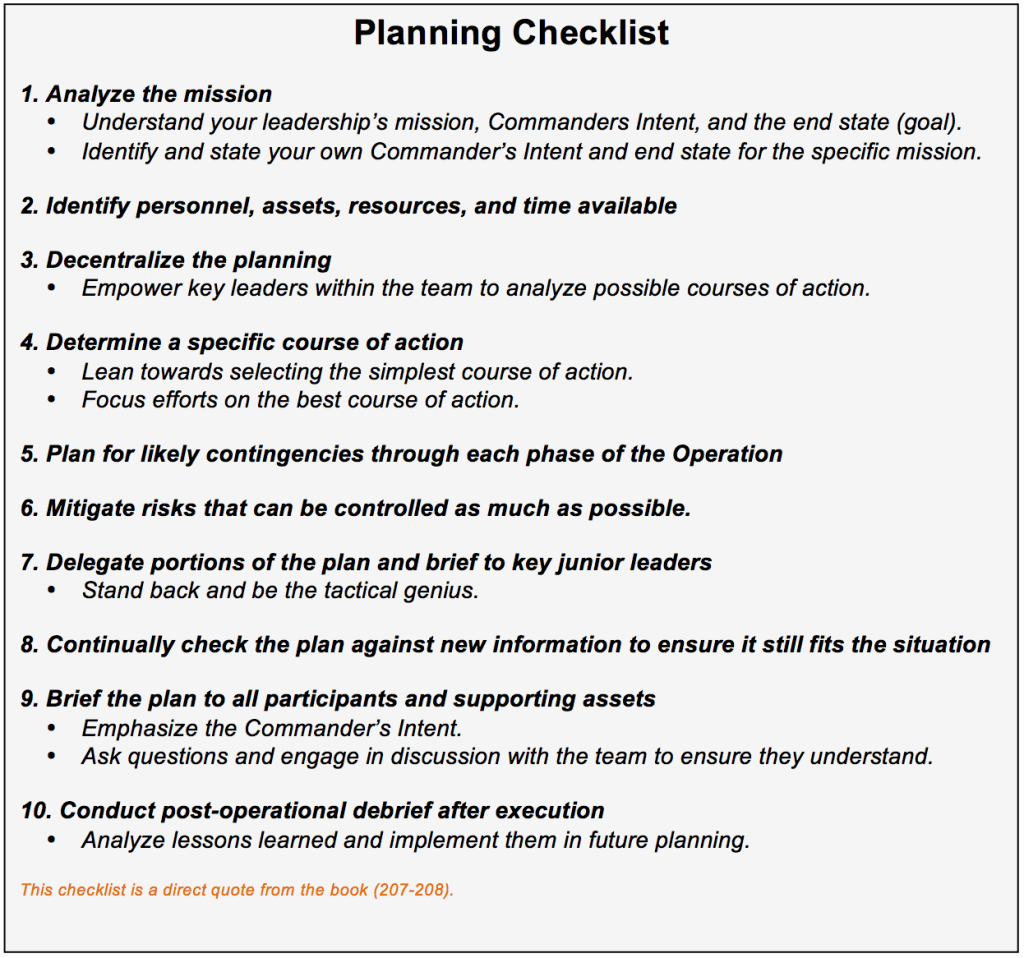
208) Repeatable checklists are a great way to standardize processes and assure quality execution, especially for use by those with less experience.
- Jocko outlines a checklist to guide you through the planning process.
Ch. 10 – Leading Up and Down the Chain of Command
Summary: Leading Down the Chain of Command
It was only after Leif and his platoon returned to the States, after months of combat executing over a hundred missions, that Leif fully understood the strategic purpose of their missions and their achievements.
- Jocko realized that even he failed to keep Leif as informed as possible on how each mission was strategically important.
- So too – Leif failed to sufficiently inform his team on the purpose behind their missions (in part because he also didn’t understand fully).
MAIN PRINCIPLE: Leaders must ensure their teams understand the purpose of their work, tying it directly to the overall strategic mission. (228)
- Always communicate the WHY behind the WHAT. Don’t assume they understand.
- Communicate down the chain of command slightly more than you think is necessary.
- It’s better to have an over-informed team than an under-informed one.
- If your team is asking questions or doesn’t understand something, you have failed to communicate sufficiently.
“If your team isn’t doing what you need them to do, you first have to look at yourself. Rather than blame them for not seeing the strategic picture, you must figure out a way to better communicate it to them in terms that are simple, clear, and concise, so that they understand.”
pg. 230
• • •
228) Let your teams be part of the planning process; this helps instill commitment via “skin in the game” and give them strategic understanding.
- Give more ownership to those who are negative; it helps them buy-in because they have more control over the outcome.
Summary: Leading Up the Chain of Command
After receiving a seemingly “idiotic” question from senior leadership about a mission plan, Leif took to venting about all of leaderships relentless and unproductive questions.
- Leif found it insulting that they continue question their abilities.
- “We waste our time answering question after question. It’s actually dangerous!”
- Jocko let Leif vent, but then helped him see things differently…
- Their leadership weren’t bad guys trying to make things harder for them, they just didn’t have the information they needed to approve the mission.
- Leadership lacked understanding because Jocko and Leif’s failed to keep them adequately informed.
“We need to push situational awareness up the chain. If they have questions, it is our fault for not properly communicating the information they need. We have to lead them.“
pg. 235
MAIN PRINCIPLE: It is your job to proactively keep your leadership informed.
- If you need more support from your boss, tell them.
- They’re not mind readers; they don’t see what you see. You must tell them.
- Ask your boss how & when they want updates, then proactively keep them informed.
- Update them so well that they have no remaining questions.
- Providing quality updates helps build their trust in your capabilities.
- Again – communicate slightly more than you think is necessary.
- If it’s too much, they’ll let you know.
- For leadership – if they will be “flying blind”, they’ll simply choose to not fly at all.
• • •
238) Lead everyone in your world, subordinates and superiors alike.
- Tell your leaders what you plan to do, rather than saying “what should I do?”
- Something like – “here’s my plan, do you have any feedback or suggestions?”
240) Your leadership clearly doesn’t want you to fail. Remember that when reflecting on policies that seem “stupid.” Try to understand their perspective rather than dismissing them.
Ch. 11 – Decisiveness Amid Uncertainty
Summary: During a mission where Leif and his team were providing overwatch support for other U.S. Forces his best sniper, Chris Kyle (author of American Sniper), identified a potential enemy sniper threat but he couldn’t get a PID (positive identification).
- Leif radioed the leader of the ground forces in the area to ensure their team was not in that building. Their response – “no, take that guy out.” They wanted quick action!
- Chris’s lack of PID gave him and Leif pause, so they refused to take the shot.
- Basic rule of firearm safety – “know your target, and what is beyond it.”
- Leif requested the ground forces re-clear the building; they reluctantly agreed.
- As soon as they went to do so, Chris and Leif quickly realized their mistake – they had misidentified the building they were looking at (an easy mistake to make in Ramadi).
- The potential “threat” in the building was friendly.
- Thankfully – Leif acted decisively amidst the uncertainty of the situation, despite pressure to act quickly. Leif’s decision likely prevented a deadly friendly fire incident.
MAIN PRINCIPLE: Leaders must be decisive, despite lacking perfect data. (254)
- If you wait until you have all the info, you’ve waited too long.
- “Outcomes are never certain”, so you usually must make the best decision with the information available to you.
- “There is no right solution. The picture is never complete”.
- Related: “There are no solutions, only tradeoffs.” – Thomas Sowell
- If new info becomes available, adjust.
- “There is no right solution. The picture is never complete”.
• • •
251) Be fast to make reversible decisions and slow/deliberate to make decisions that are hard (or impossible) to reverse.
- Related: This is similar to Jeff Bezos’s philosophy on decision making. The metaphor he uses is one-way and two-way doors.
- One-Way Doors: Irreversible decisions. Take your time to make the best decision.
- “Some decisions are consequential and irreversible or nearly irreversible – one-way doors – and these decisions must be made methodically, carefully, slowly, with great deliberation and consultation.” – Bezos
- Two-Way Doors: Easily alterable. Decide fast with the data available. If things change, then adjust (again – quickly).
- “You don’t have to live with the consequences for that long (for Type 2 decisions). You can reopen the door and go back through.” – Bezos
- One-Way Doors: Irreversible decisions. Take your time to make the best decision.
Ch. 12 – Discipline Equals Freedom
Summary: After clearing a building for threats during missions, Jocko’s teams would then search for evidence of terror activity – contraband, weapons, explosives, etc.
- There was no initial clearing “strategy”. It was an unorganized ransack.
- They often had to re-clear rooms to ensure they hadn’t missed evidence.
- After implementing a more disciplined and structured operating procedure, they reduced the time it took to clear a building by ~80%, from 45 minutes to 10 minutes.
- The also recovered more evidence, as their organized approach helped ensure they didn’t miss rooms – which had happened in the past.
- Although Jocko’s team was reluctant at first, they quickly realized the value of the new system. It required discipline, but it bought them more time to do more missions.
MAIN PRINCIPLE: You earn more freedom through disciplined action.
- You can earn free time by diligently completing your tasks without getting distracted.
- Efficiently completing tasks through discipline saves you time.
- You can earn physical freedom (long-term) by being disciplined with your fitness.
- You can earn financial freedom by being disciplined with your finances.
- You can earn freedom from your own impulses by mastering yourself.
• • •
271) Getting out of bed is key to discipline; it’s a good place to start.
- You either begin your day with a win or loss, so it’s an important habit.
- Getting up early is an easy way to find more free-time in your life.
273) Disciplined and well-organized processes allow you to quickly adapt to changing circumstances. They give you a framework from which you can be creative within.
274) Leadership requires balance; much of leadership requires skillful management of dichotomies between opposites, such as:
- “Be confident, not cocky; courageous, not foolhardy; competitive, but a gracious loser.
- A leader and a follower; humble, not passive; aggressive, not overbearing.
- Quiet, not silent; logical, but not emotionless; detailed-oriented, but not obsessed.
- A leader and a follower; close with subordinates, but not too close.
- Exercises both Extreme Ownership and Decentralized Command.
- A good leader has nothing to prove, but everything to prove.”
- Related: “Every virtue taken too its extreme can become a vice.” – Unknown
Jocko and Leif expand on this idea in their second book: The Dichotomy of Leadership
Afterword
Summary: Leaders are made, not born. Some may have a slight advantage due to nature characteristics, but natural ability alone won’t make you a good leader. The determining factors will be their ability to continually learn and grow into the role of a leader.
With this in mind, senior leaders should focus heavily on training and mentoring those lower in the chain of command. For their organization or team to succeed once they move on, they must prepare others to replace them when they are gone. If they don’t, they’ve failed the organization.
“The goal of all leaders should be to work themselves out of a job.”
pg. 294
All leaders make mistakes; your team will expect you to make mistakes. What matters is that you handle them with humility and honesty. No one respects someone that can’t take ownership of their mistakes. Plus – if deny being at fault, you won’t learn. Keep the Ego under control, stay curious, and keep improving every day.
“Leadership is both art and science.” Accept that leadership is difficult, but it’s also rewarding. This book provides guides and helpful frameworks to handle many situations, but you will use your experience and personality to best handle each situation on a case-by-case basis.
Appendix Q&A
What advice do you have for new leaders? (Jocko Podcast #1)
295) “Number one: be humble.” Respect others – their perspectives and opinions.
- Related Quotes About Humility:
- “Humility isn’t about decreasing your regard for yourself but increasing your regard for others.” – Alex Hormozi
- “It is better to presume ignorance and invite learning than to assume sufficient knowledge and risk the consequent blindness.” – Jordan Peterson
- Build relationships! The people that really follow you are the ones you have relationships with, not people you simply bark orders at.
- Work hard. Be truthful. Act with integrity.
- When your team makes a mistake, first recognize how you contributed to it, then seek a solution. Give credit to your team for successes.
• • •
How do I get over feeling like an imposter as a new manager? (Jocko Podcast #19)
295) Recognize that it’s ok to not know everything.
- Admit to your team that you don’t know everything but are eager to learn and support them. Ask good questions and listen to others.
- You may not be an expert now, so you must study and learn quickly.
- Make up for your ignorance with hard work.
296) Don’t pretend to know something you don’t.
- Just be honest and direct. Others will respect you for not lying to them.
- Plus, those that “know” can easily spot someone who doesn’t.
• • •
Is there a way to practice hard conversations? (Jocko Podcast #34)
297) Rehearse difficult conversations – role play.
- Start with an easy scenario and then work your way up to more difficult conversations.
- “Good performances come from rehearsal.”
- Although being direct is important and necessary in certain circumstances, you will generally get better results by correcting behavior indirectly.
- Think chess, not checkers.
• • •
What advice do you have for people who have weak leaders? (Jocko Podcast #47)
299) You lead them. Pick up their slack. You do their job. That’s an opportunity to get better. “You will win in the long run.”
- Just make sure you’re not stepping on their toes. Give them the credit for team successes. You don’t want them to be overly intimidated by you.
301) Ask them, “would__________ be a good idea?”
- Make them think it’s their idea; make sure they feel in control.
- Be careful not hurt their Ego. Not because they necessarily deserve your utmost respect, but because you need to have a good relationship with them if you want to be effective in your role.
302) Insecure leaders are the ones you must watch out for.
- For leaders: if one of your subordinates is stepping up, good. Do better yourself. Improve. Use their excellence to propel you forward.
303) Take advantage of the opportunity to assume more responsibility than your role requires. Make things happen. Step up and lead.
• • •
Does micromanaging ever work? (Jocko Podcast #32)
303) Micromanaging not only works – it is necessary (at certain times).
- Think of micromanaging as close mentorship. You invoke it when someone’s performance is not where it needs to be, either because they are new to the role or because they aren’t meeting expectations.
- Micromanaging should be a temporary means of getting to Decentralized Command.
- The goal of micromanaging is to improve their performance so they can be trusted to do their work without as much oversight.
- “Once you can do it on your own, you will be on your own.”
- Once they are up-to-speed, you must step back and let them do their work.
- Again – “The goal of all leaders should be to work themselves out of a job.”
• • •
How does a leader recover from mistakes? (Jocko Podcast #12)
307) Accepting ownership for the mistake is the quickest path to regaining the trust of others and correcting it going forward. From then on out, just continue to do excellent work, following through on commitments and keep the quality of your work exceptionally high.
 Just the Gist