NOTES
BOOK ONE: RESISTANCE
CHAPTER SUMMARY
Pressfield begins by defining the core idea in this book – “Resistance”. Resistance is everything that keeps us from doing our work. He conceptualizes it as an evil force that is indifferent, relentless, and powerful. It comes from within and takes many forms: fear, shame, distraction, self-doubt, rationalization, procrastination, preparation, victimhood… the list goes on.
- Resistance is the urge to cheat on your diet.
- It is the temptation to pick up the phone when you know you should be working.
- It’s like walking upstream in a river, if we lose focus or stop trying, it’ll sweep us away to a place we don’t want to be.
The more important the work or endeavor, the stronger Resistance presents itself. As such, use your fear, anxiety, and distractibility as an inverted compass to point you towards what you should be doing. Does the idea of putting pen to paper make your skin crawl? Good. That’s a signal that it’s important and you should do it.
Resistance is strongest when you are closest to the finish line. It knows we’re about to win, so it throws a Hail Mary attempt to stop us. Beware and push through.
You must respect Resistance. You are most vulnerable when you feel in control. If you think you’ve outwitted Resistance, it has the upper hand; it will find a way to overcome you when you least expect it.
It impacts writers and artists from doing their work, but Resistance is also there in simple moments:
- Your kids want to play, but you’re too busy catching up on the news.
- You have dessert when you know you shouldn’t.
- You scroll when you should read, write, or rest.
Resistance is fear, and fear can be crippling. But it doesn’t always look like fear. We make excuses for our fear to rationalize the fact that we are avoiding our work – so we don’t look like a coward. Self-doubt, perfectionism, and even our own sickness (it’s the best excuse)… all these can be Resistance in disguise.
Resistance can come from those around you too. Once you start to consistently conquer Resistance, others may not appreciate it, possibly because it makes them look bad. We’re a buzzkill. So, they may try to bring you down (consciously or unconsciously):
- “Come on, it’s just one drink.”
- “It’s just a piece of cake.”
- “You’ve changed.”
- “You have other responsibilities other than wasting time on ________.”
If you’re not careful, Resistance through others can be a potent source to contend with. The opposite is true for those around you that consistently overcome their own Resistance. Those doing their life’s work seldom critique others. Rather, they encourage and uplift.
Self-doubt can be a good thing. It reveals that we admire the craft so much that we have a hard time seeing ourselves as worthy participants. It shows our love of the art. Conversely – overconfident and arrogant people often act that way because they haven’t done enough work to realize the effort required to be great. The process to mastery looks something like this:
1. Uninformed optimism (confident beginners)
2. Informed pessimism (humbled intermediates)
3. Informed optimism (mastery)
◊ ◊ ◊
x) “If you believe in God (and I do) you must declare Resistance evil, for it prevents us from achieving the life God intended when He endowed each of us with our own unique genius.”
21) “Procrastination is the most common form of Resistance because it’s easiest to rationalize. We don’t tell ourselves, ‘I’m never going to write my symphony.’ Instead we say, ‘I am going to write my symphony; I’m just going to start tomorrow.”
24) “Trouble is a faux form of fame.” This is one reason why toddlers and teenagers cause trouble – it gets them the attention they seek. Some adults do this as well, in trivial and non-trivial ways, to gain attention when they feel neglected.
37) “The truly free individual is free only to the extent of his own self-mastery.” – Socrates
42) “The opposite of love isn’t hate; it’s indifference.”
BOOK TWO: TURNING PRO
CHAPTER SUMMARY
Resistance fears the pro, as the pro is equally relentless, confidently overcoming resistance daily. Pressfield describes the pro as fully committed, no longer working part-time on their work, but rather showing up as a dedicated employee would at their 9-5.
- Rain or shine, sick or tired… the conditions surrounding the work don’t matter much (family emergencies or dire health issues excluded).
- The pro finds a way to put in the hours and performs when the performing needs done, because the stakes are high. The amateur lacks the love of a pro, otherwise they’d pursue it beyond the weekend and spare time.
Pros know the “principle of priority” which is first, to know the difference between what’s urgent and important, and second, to do what’s important first. Pros are focused (“locked in”).
Having overcome resistance and done our day’s work, the pro can rest knowing he’s earned his spot on this spinning planet, at least for today. We’re most at peace with ourselves when we’ve done our best.
The pro exposes their work to the judgement of others; they don’t hide it. In doing so, they make progress in leaps and bounds compared to the amateur that never gets feedback (good or bad). The pro contends with reality and is empowered by doing so.
BEWARE YOUR ENTHUSIASM
Resistance uses the amateur’s enthusiasm against him. How? By inflating his short-term expectations to be unachievably high such that they are destined to be let down and deflated when things don’t go to plan. We fail and most stop there…
- Related: “Most people overestimate what they can achieve in one year and underestimate what they can achieve in ten years.”- Bill Gates
- The professional is patient. The amateur is overly enthusiastic; he’s excited, but his excitement will lead him to burnout quickly as progress won’t happen as quickly as his enthusiasm expects.
- Related: “Patience is bitter, but its fruit is sweet.” – Jean-Jacques Rousseau
- The pro is orderly, not chaotic.
- He breaks down the ephemeral into the practical, demystifying that which seems hard to grasp. In doing so, he can focus on what matters.
- He doesn’t make excuses; he plays the cards he’s been dealt.
- The pro has his ego in check. He knows that he can still learn from others and seeks help and feedback. Tiger Woods, arguably the greatest golfer of all time, has a coach. This is true for many other top performers.
- A pro doesn’t take wins or loses personally. They’re all opportunities for learning and improvement. They recognize that they’re only responsible for the work, not the result. They can rest in knowing they did their best.
- The pro maintains their control despite external factors. They have composure and temperance.
- The pro understands that he is both a manager and laborer. Creating space between ourselves and the creator can help us be more objective and graceful throughout our career.
The pro respects Resistance. He knows that if he lets down his guard for a moment, Resistance will take over.
◊ ◊ ◊
1) “It is one thing to study war and another to live the warrior’s life.” – Telamon of Arcadia
64) “I write only when inspiration strikes. Fortunately, it strikes every morning at nine o’clock sharp.” – Somerset Maugham
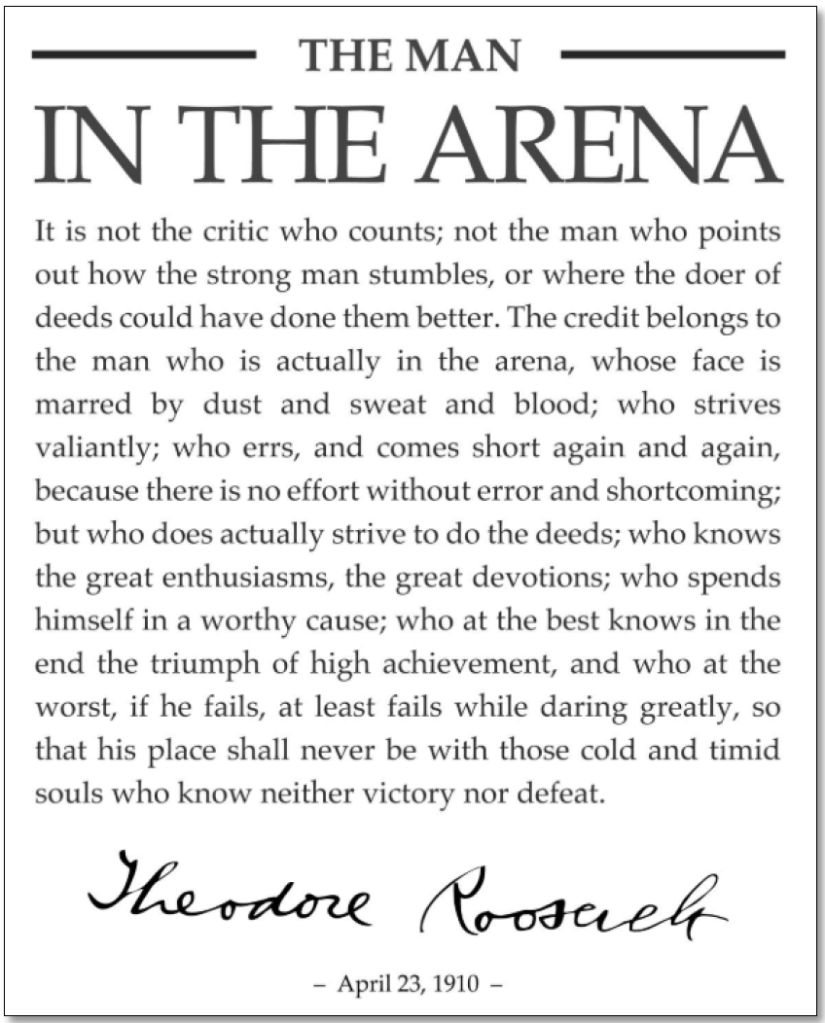
72) “So you’re taking a few blows. That’s the price for being in the arena and not in the sidelines. Stop complaining and be grateful.”
- Related: Teddy Roosevelt’s “Man in the Arena” captures the blows a pro will need to take whilst in pursuit.
BOOK THREE: THE HIGHER REALM
CHAPTER SUMMARY
When we sit down to do our work, committed and energetic, there are forces that conspire to help us win the battle against Resistance. We don’t understand these forces fully, but they seem to exist.
- Pressfield refers to these forces as muses (daughters of Zeus), and he believes they “delight“ in watching us timebound creatures create. Why?
- Maybe because their infinite nature makes creation pointless.
- Or possibly because, given the shortness of our lives, creating is a sacrificial act making it especially meaningful.
- Regardless – they are present, helping us along our way.
- We’d be wise to recognize their part, respect their guiding force, and be open to receiving their gifts of inspiration.
- Pressfield begins his work each day with a prayer, taken from the Odyssey… o “O Divine Posey, goddess, daughter of Zeus, sustain for me this song of the various minded man who, after he had plundered the innermost citadel of hallowed Troy, was made to stray grievously about the coasts of men, the sport of their customs, good or bad, while his heart, through all the sea-faring, ached with an agony to redeem himself and bring his company safe home. Vain hope – for them. The fools! Their own witlessness cast them aside. To destroy for meat the oxen of the most exalted Sun, wherefore the Sun-god blotted out the day of their return. Make this tale live for us in all its many bearings, O Muse…”
Rationalists may be skeptical of this view, and that’s ok. If they like, it can be thought of as a law of physics – like gravity. An ever-present force of reality, but in this case it’s there “over ever blade of grass cheering it on saying –‘grow!’”
THE MYSTERY OF INSPIRATION
It’s curious though, where does “inspiration” come from? From what, where, or whom?
- Pressfield believes that inspiration comes from whispers from the muses. It’s as if they are directing us to create. Most don’t hear the whispers, but some do, and they grab it and act.
- Maybe the 9th symphony existed in the ether before Beethoven sat down and played “duh duh duh DUM…” Maybe all creative acts come from this source?
- Related: This seems to align with Rick Rubin’s position as well. His analogy is that there is a conveyor belt of gifts available to us from a higher force (God). Most don’t believe it’s there, but those that do and are open/aware/ready can pick a gift up, “unwrap it”, and use it to create art.
DON’T BE A SELL-OUT
Don’t sacrifice the sacred for the profane; don’t sacrifice your art (soul) for commercial needs. To Pressfield, that is “prostitution”.
- We do art for its own sake, not for money. If money comes, ok. If it doesn’t, ok. If we create something with an audience in mind, we sully our work.
- It’s pandering. We don’t know what others will like; it’s hard enough to understand what we ourselves like.
- Related: “Don’t ask yourself what the world needs. Ask yourself what makes you come alive, and go do that… Because what the world needs is people who have come alive.” – Howard Thurman
- Even if we succeed at pandering (catering our work to what we think others will like), we still lose as we’ve “sold out our Muse, and your Muse is you, the best part of yourself, where your finest and only true work comes from.”
- Pressfield leaned into this idea with The Legend of Bagger Vance (a book about golf) where he followed his own creative desires rather than trying to create something the market might want. To his surprise, it did well commercially. Why?
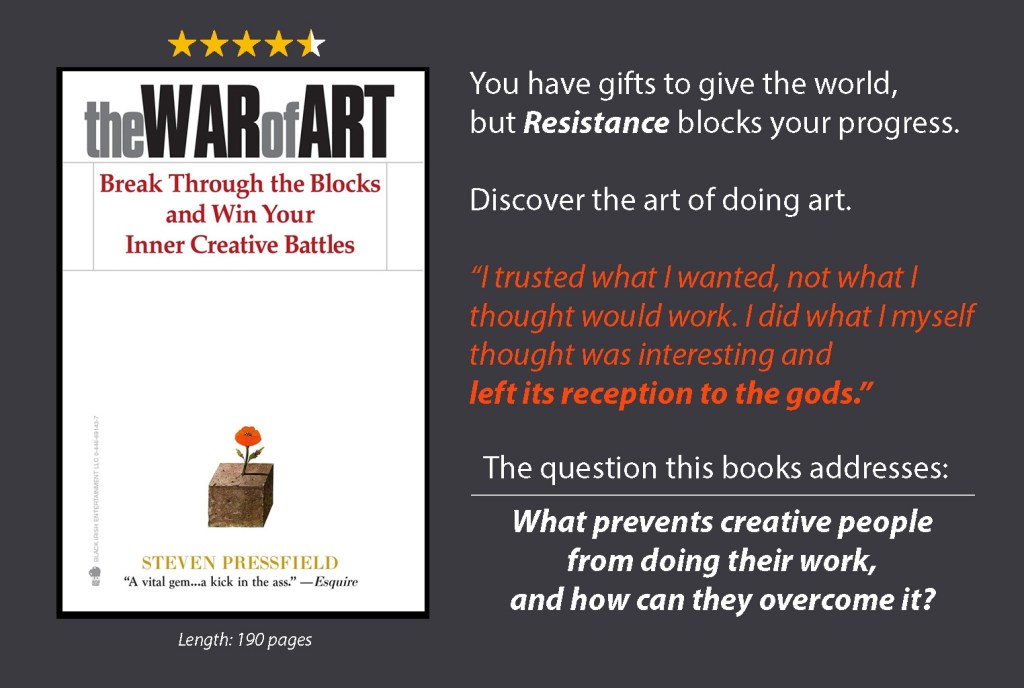
“I trusted what I wanted, not what I thought would work. I did what I myself thought was interesting and left its reception to the gods.”
Pressfield argues that anyone who is doing their work in a hierarchical manner (i.e., seeking the approval of others for validation) is playing the wrong game. That game won’t sustain you.
- You won’t create your best work because it’s not what you’re most interested in.
- Rather, find your territory.
- Find the work that gives you energy, that you would do even if you were the last person left on this planet. This is true creation. It’s natural and impulsive. It’s personal and true to you.
- Doing what genuinely interests us fills our souls and energizes us like nothing else.
- Related: “Don’t try to be someone, rather find the thing that is so engaging that it makes you forget yourself.” – Boyd Varty
NEW ASSIGNMENT
If we believe that we are inspired by the Divine, then it is “spiteful to the Almighty” to ignore what inspires us.
- Our inspiration is a signal that “you’ve been assigned this work.”
- Carry out your duty with discipline and enthusiasm. In doing so, you are giving back to God what God has given you. What you create is an act of worship to God.
- Related: Rick Rubin put it beautifully in a podcast episode with Jay Shetty: “It’s all an offering God. And if you’re making an offering to God, you’re not thinking about ‘oh, what’s the budget?’ or ‘I hope this segment of the audience is going to like it.’ We don’t think like that. It’s a higher vibration. We’re making the best we can make, to the best of our ability, out of love and devotion. That’s what it is. And there is no ‘I’m changing it for someone else’ because it can’t be better than this devotional act we are doing. There is no higher form.”
The true artist is modest because they recognize they’re just following orders from something outside themselves. Ultimately – the world is counting on you to search and listen for God’s whisper of direction, and given this guidance, to follow it with dedication.
- As Pressfield put it – “Don’t cheat us of your contribution…. Give us what you got!”
THE ARTIST’S LIFE
“Are you a born writer? Were you put on earth to be a painter, a scientist, an apostle of peace? In the end the question can only be answered by action.
Do it or don’t do it.
It may help to think of it this way. If you were meant to cure cancer or write a symphony or crack cold fusion and you don’t do it, you not only hurt yourself, even destroy yourself. You hurt your children. You hurt me. You hurt the planet.
You shame the angels who watch over you and you spite the Almighty, who created you and only you with your unique gifts, for the sole purpose of nudging the human race one-millimeter farther along its path back to God.
Creative work is not a selfish act or a bid for attention on the part of the actor. It’s a gift to the world and every being in it. Don’t cheat us of your contribution. Give us what you’ve got.”
◊ ◊ ◊
108) “Nothing else matters except sitting down every day and trying.”
119) “There is magic to effacing our human arrogance and humbly entreating help from a source we cannot see, hear, touch, or smell.”
122) “Whatever you can do, or dream you can, begin it. Boldness has genius, magic, and power in it.” – Goethe
134) Your unlived potential manifests as poison to the soul. Tom Laughlin works with cancer patients and suggests that failure to live the lives we were destined for could result in the growth of cancer. Could it be that if we choose to grow, the cancer would cease? Tom thinks so…
140) “The instinct that pulls us toward art is the impulse to evolve, to learn, to heighten and elevate our consciousness.”
146) “Our job in this lifetime is not to shape ourselves into some ideal we imagine we ought to be, but to find out who we already are and become it…if we were born to paint, it’s our job to become a painter.”
148) The problem with hierarchies is they kill the soul at scale. The individual is lost when the group becomes too large.
- “A pecking order can hold only so many chickens.”
- We evolved within small tribes, so that is what we are programmed to be familiar with.
150) “The artist cannot look to others to validate his efforts…he must do his work for its own sake.” The doing is enough.
• A “hack” is someone who creates his work with the intention of pleasing the market.
160) “Contempt for failure is our cardinal virtue.” Failure, that is, as defined by ourselves.
- It’s a failure to live up to our own expectations and to fulfill our God given potential.
163) We are “instruments of the gods.”
 Just the Gist