The Gist
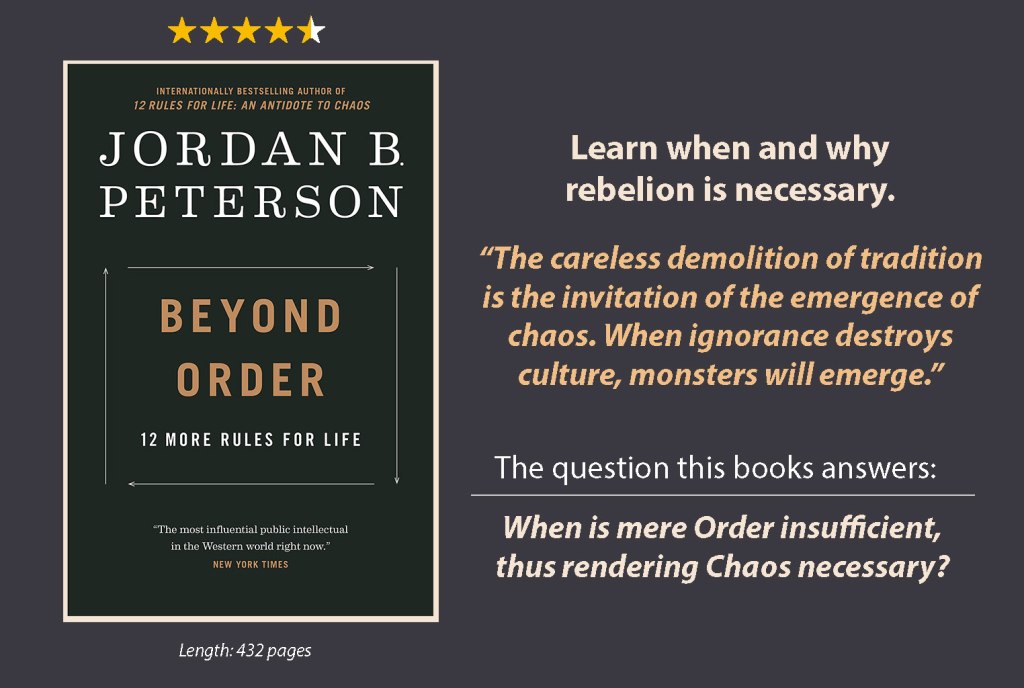
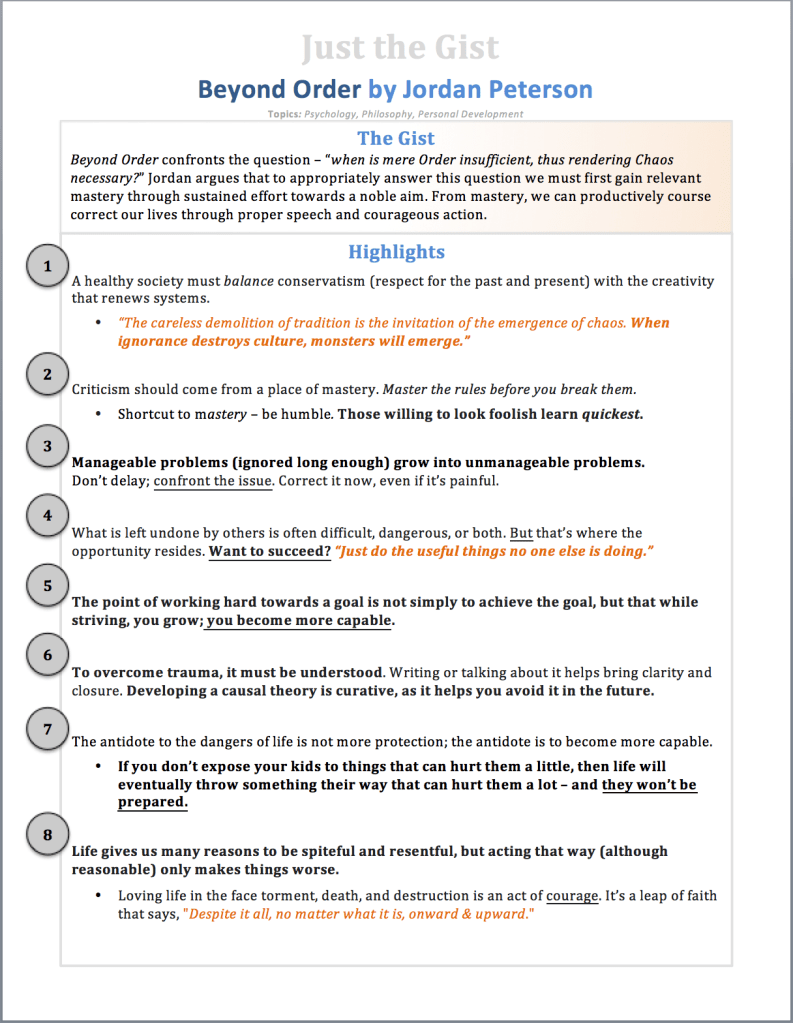
Beyond Order confronts the question – “when is mere Order insufficient, thus rendering Chaos necessary?” Jordan argues that to appropriately answer this question we must first gain relevant mastery through sustained effort towards a noble aim. From mastery, we can productively course correct our lives through proper speech and courageous action.
Highlights
- A healthy society must balance conservatism (respect for the past and present) with progress (the creativity that renews systems).
- “The careless demolition of tradition is the invitation of the emergence of chaos. When ignorance destroys culture, monsters will emerge.”
- Criticism should come from a place of mastery. Master the rules before you break them.
- Shortcut to mastery – be humble. Those willing to look foolish learn quickest.
- Manageable problems (ignored long enough) grow into unmanageable problems. Don’t delay;confront the issue. Correct it now, even if it’s painful.
- What is left undone by others is often difficult, dangerous, or both.But that’s where the opportunity resides. Want to succeed? “Just do the useful things no one else is doing.”
- The point of working hard towards a goal is not simply to achieve the goal, but that while striving, you grow; you become more capable.
- To overcome trauma, it must be understood. Writing or talking about it helps bring clarity and closure. Developing a causal theory is curative, as it helps you avoid it in the future.
- The antidote to the dangers of life is not more protection; the antidote is to become more capable.
- If you don’t expose your kids to things that can hurt them a little, then life will eventually throw something their way that can hurt them a lot – and they won’t be prepared.
- Life gives us many reasons to be spiteful and resentful, but acting that way (although reasonable) only makes things worse.
- Loving life in the face torment, death, and destruction is an act of courage. It’s a leap of faith that says, “Despite it all, no matter what it is, onward & upward.”
Full Notes
Rule I: Do Not Carelessly Denigrate Social Institutions or Creative Achievement
Summary: Social institutions will inevitably be somewhat corrupt (they’re run by humans), but they still serve a critical function in civil society. We must balance conservatism (respect for the past and present) with the creativity that renews systems. Too much of either is bad. To appropriately strike that balance, we must thoroughly understand the systems we wish to conserve, renew, or replace. Master the rules before you break them.
3) We think by expressing thoughts outwardly – through speech and writing. “We mostly think by talking.” Being social allows us to think and evolve into as social creatures.
7) When you give someone your attention, you communicate their value and the value of what they have to say.
- Your attention is an expression of what you value.
- Related: Babies point to compel the attention of others. If adults don’t respond or engage, babies notice their disinterest and will point less. The book Curiousby Ian Leslie covers this.
10) We make decisions that benefit others and ourselves, not only in the present, but in the future as well. Ideally, we optimize our behavior for what’s best for society across time.
14) Jean Piaget: “Play” with others depends on a shared goal between those participating.
- Piaget’s Claim: games or systems that people voluntarily choose to play will out-compete compulsion. Why? You must waste resources on the enforcement of a non-voluntary game.
- “The purpose of the repeated game is not dominance, but continuing play.”
- If you dominate the game by cheating, no one will play with you again.
- Study of play in rats: If two rats engage in wrestling (play), and the bigger rat doesn’t let the smaller rat win 30-40% of time, the little rat will stop playing.
- Win and lose with class. This is why your parents and coaches always said: “It’s not whether you win or lose. It’s how you play the game.“
- “The purpose of the repeated game is not dominance, but continuing play.”
- “Humility: It is better to presume ignorance and invite learning than to assume sufficient knowledge and risk the consequent blindness.”
- The Fool precedes the Master, as he humbly learns and grows while others pretend to know. The Fool is willing to look foolish; this willingness is essential to learning.
- Those who are willing to look foolish learn quickest.
· Related: “It is impossible for a man to learn what he thinks he already knows.” – Epictetus
- Humility is being in love with what you don’t know rather than what you know.
- Children without at least one close friend are more likely to suffer later psychologically.
- Friendships are critical for adults too. Friends that provide support benefit, both mentally and physically, just as much (if not more) than those that receive support.
- Authority is not merely power, and it is a mistake to confuse the two.
- Authority = competence + good will + support of others + influence
- “Genuine authority constrains the arbitrary exercise of power.“
29) Conform to the collective or rebel? Both have a time and place. The challenge is knowing when to fall-in-line and when to stand your ground as an individual.
30) Corruption is inevitable in human systems.
- The important question is:
- Does the current system have a means of error correction?
- Can the corruption be filtered out without violence? If not, that’s a problem.
- Culture and structure can be corrupt, but we must not lazily criticize them. Critique must be well thought through.
- Conservatism and creative transformation are both necessary, but both have a set of associated dangers.
- Conservatives should recognize the dangers progressing too slow, and progressives should recognize the dangers of progressing too fast
- Respect and follow the law while learning it; once mastered, your conscience may lead you to act contrary to the law but consistent with the spirit of the law.
- Mastery enables the creative force that expands and renews system.
- Discipline = Freedom of Creativity
- “Genie – genius – is the combination of possibility and potential with extreme constraint.”
- The constraints of discipline lead to possibility.
- Related: “Discipline Equals Freedom” – Jocko Willink
37) Stories allow us to imitate behavior without explicitly understanding why we do what we do.
- Related: “WWJD” (“what would Jesus do?”) – The fundamental purpose of religious narrative is to motivate imitation.
- Other helpful questions to inform “good” behavior through imitation:
- What would a healthy person do? (For good health habits)
- What would a good father/husband/friend do? (For good relationships)
- What would a billionaire do? (For good money habits)
- What would [insert your person you wish to be more like] do?
- Other helpful questions to inform “good” behavior through imitation:
40) To productively renew the system, you must understand the rules well enough for you to see its flaws and gaps. Only then should you introduce creative chaos into the system.
- This careful creativity from authority is what renews the game.
- Bonus: The process renews you at the same time, as you gain a better understanding of life.
41) In Harry Potter – Harry, Ron, and Hermione break the rules when they are guided to do so by their conscience. And their rule breaking is rewarded!
- The password to open the Marauder’s Map – “I solemnly swear that I am up to no good.” Once they are done with the map, they say the phrase “mischief managed” to close the map.
- Managing “mischief” properly (i.e., breaking the rules in the right way) is good.
- The story doesn’t propose “drone-like” following of rules as the highest moral good.
42) “Follow rules, except when doing so undermines the purpose of those self-same rules – in which case take the risk of acting in a manner contrary to what has been agreed upon as moral.”
- If following the rule would be contrary to the intent of the rule, break the rule. But to know the intent of the rule, you must first have an expert understanding of the rule.
- Jesus Christ (The Rule Breaker)
- As an adult he repeatedly broke Sabbath (doing miracles) because he transcended the simple rule… becoming the moral exemplar.
- He acted out the spirit of the rule rather than the dogma.
46) “If you understand the rules – their necessity, their sacredness, the chaos they keep at bay, how they unite the communities that follow them – but you are willing to fully shoulder the responsibility of making an exception, because you see that as serving a higher good, then you have served the spirit, rather than the mere law, and that is an elevated moral act.”
- “O Man, if indeed thou knowest what thou doest, thou art blest; but if thou knowest not, thou art accursed, and a transgressor of the Law.” – Gospel of Luke (Codex Benzae)
Rule II: Imagine Who You Could Be, and Aim Single Mindedly At That
Summary: The hero in life is he or she who is able to pay attention to what needs attended to, will voluntarily face the challenges of life, and use their words and actions to right wrongs. There is danger in this path, but it is the way to fulfill our potential and to confront evil in the world.
52) Stories often speak to something we know deeply, but that we do not fully understand. Stories communicate to us in ways was can’t explicitly describe.
56) Every society is already characterized by patterned behavior. If this were not true, we would live in pure conflict. Patterned behavior is part of culture.
57) Unforgettable stories advance our understanding of our nature, our actions, and ourselves.
- We don’t always understand why we do what we do. Stories help us understand.
- Even when we don’t understand, we can imitate the behavior by observation.
58) Who would you be, if you were all you could be?
- Related: Do we have a responsibility to fulfill our potential?
- “If you could do better, should you?” – Jim Rohn
- According to Charlie Munger, yes… “Wisdom acquisition is a moral duty.”
61) The “snitch” in Harry Potter is similar to the “random chaos” symbol in Alchemy.
- Both represent where our attention is drawn unconsciously.
- The Seeker pursues what is most important in the midst of complex, competing obligations.
65) “You do not choose what interests you. It chooses you.“
69) Our default view of reality is not objective; it is emotional, narrative based, and intuitive. We have evolved that way.
- It takes effort to be objective; the subjective world of stories is more natural.
70) Mesopotamian Myth Ethic: “the careless demolition of tradition is the invitation of the emergence of chaos. When ignorance destroys culture, monsters will emerge.”
- The hero, Marduk, is born with eyes encircling his head and can speak “magic words”
- Qualities of a Hero: Careful attention, effective language, courage, strength, and the willingness to voluntarily confront the unknown (chaos) to restore order.
Side Note: Peterson’s goal seems to be to make implicit stories explicit. In doing so, we can:
- Know thyself – better.
- Consciously act out the good explicit behavior and avoid the bad.
- Help others improve by communicating these ideas clearly.
75) Evil is overcome by the voluntary acceptance of life’s suffering.
78) Harry Potter gains access to the labyrinth through the sewers. “In filth it will be found.”
- “That which you most need to find will be found where you least wish to look.“
- The voluntary confrontation of fear is curative.
- Related: Jung’s idea of the Shadow is that we must attend to what we avoid about ourselves.
80) “Who dares, wins – if he does not perish.”
- The hero incorporates their dark side (Shadow).
- Bilbo was a thief. Harry was touched by evil.
83) Let your bad ideas die so you can be renewed.
- Related: “Growth for the sake of growth is the ideology of the cancer cell.” – Edward Abbey
- Parts of you that no longer serve you must die for you to continue to grow.
83) A test for children: Ask them to explain why they act that way they do, especially when mimicking others. Their explanation will be less complete then their actions demonstrate.
- “It’s easier to represent a behavioral pattern with behavior than with words.”
- Related: “Man is the creature who does not know what to desire, and he turns to others in order to make up his mind. We desire what others desire because we imitate their desires.” – René Girard
85) Re-occurring theme: The spirit of the rule must transcend dogma.
86) Imagine and Take Aim:
- Take aim at something lofty, and map your path forward.
- “Stumble towards your aim.”
- Attend to what is most important, in life and in the moment.
- Be biased towards action. “Voluntarily confront what stands in your way.”
- Impatient with action; patient with results.
- Speak truthfully and clearly. Words matter – a lot.
- Let your outdated perceptions, thoughts, and habits die so you can be renewed.
- Refine your aim (course correct) as you move towards your aim.
- Your aim will always move and recede, as it will grow when you grow.
- Your aim doesn’t need to be perfect; it just needs to move your forward.
Rule III: Do Not Hide Unwanted Things in the Fog
Summary: Small “dragons” that get ignored grow into unmanageable dragons that overwhelm us. It’s important to confront what we wish to ignore – feelings, tasks, conversations, etc. Anything that happens daily (no matter how small) is important, because it’ll happen 10,000+ times in your life.
91) “Do not pretend you are happy with something if you are not.” Confront it. Better to correct it now, even if it’s painful, than let resentment or anger build up.
- “Small” things that happen daily aren’t small.
- “Life is what repeats, and it is worth getting what repeats right.”
- Related: “A person’s success in life can usually be measured by the number of uncomfortable conversations he or she is willing to have.” – Tim Ferris
94) “Things fall apart on their own accord, but the sins of men speed their deterioration.”
97) Willful Blindness: Knowing you should learn something, but you intentionally don’t. This deliberate ignorance is used so you can opportunistically claim ignorance (plausible deniability).
- “Failing to look under the bed when you strongly suspect a monster is lurking there is not an advisable strategy.”
101) “When ignorance is bliss, it is folly to be wise.” → Peterson argues against this.
- Ignorance is bliss until the dragon grows too large and consumes you.
101) “The fog that hides” is our refusal to attend to our emotions. Even if we attend to them, it can also be the refusal to communicate those emotions to others.
- The fog delays our inevitable and necessary confrontation with reality.
103) “Every ideal is a judge.“
- Our ideal says to us – “this is what you could be.”
- Failure to live up to the ideal brings judgment on us.
- We (our conscience) are our own judges, since we know when we fail our ideal.
103) We learn from failure, so if you’re not working towards a goal (an ideal) then you lack the feedback of failure as you strive.
- You can’t learn if you can’t fail. And you can’t fail if you don’t set the conditions for success or failure. So you must set the conditions for success to learn from your effort.
104) Have non-naive trust with others. Know they may fail or betray you, but choose to trust because it brings out the best in both you and them.
107) What you’re self-conscious of is a good indication of where you should focus your attention to improve yourself. Anxiety and fear are useful signals, if you pay attention and act intelligently. If you avoid what you fear, things get worse.
Rule IV: Notice That Opportunity Lurks Where Responsibility Has Been Abdicated
Summary: When you see “wrongs” in the world, maybe it is your job to take on that responsibility and right them? It’s not fair, but you will benefit from doing so. The responsibility you assume to achieve a defined goal is also responsible for your psychological health (happiness). So do it. Bear the biggest burden you can.
112) If you notice a problem when no one else does, is it now your problem to solve?
112) What is left undone by others is often difficult, dangerous, or both. But that’s where the opportunity resides. Find success by doing the hard things others won’t do.
- If you and you alone see a problem, then that problem is yours.
- How to find success at work: “just do the useful things no one else is doing.”
- Can’t manage that? Become someone capable of managing it.
113) Adopting responsibility is the path to sustained meaning.
- Responsibility leads to difficulty. Easy things aren’t usually fulfilling.
- Difficulty is meaningful in-so-far-as it is productive in some way (i.e., you have a WHY.)
114) “Life is suffering (dukkha)” is a core philosophy of Buddhism.
114) The Greek word “hamartia” (sin) means, “to miss the mark”. It’s originally an archery term.
115) People regret failure to try more than failure while trying. At least you gave it a go.
- Related: “You may not be able to do all you find out, but you should find out all you can do.“ – Jim Rohn
117) Aim at something! Just try your best. Otherwise, you’ll have all of the suffering of life with none of the meaning. That’s one form of hell on earth.
119) The Structure of the Story of Osiris and Horus:
- Chaos leads to order.
- Order stagnates or is usurped by the evils of men and turns tyrannical.
- Chaos must generate heroes to disrupt and overcome tyranny to restore Order.
- The renewed Order should be youthful in that it does not stagnate and become blind.
- Archetypal Heroes are born when things are at their worst (often born in simple means).
121) Voluntary confrontation of a feared, hated, or despised obstacle is curative.
- Related: Writing down your fears reduces their intensity. Harvard source here.
- See also Tim Ferris’s Ted Talk on fear setting – here.
122) Optimal responsibility is when you feel like you are right on the edge of your capabilities. It’s difficult enough to stretch you, but not so difficult that it crushes you. Effective responsibility should:
- Compel you forward without being too scary.
- Grip your interest without overwhelming you.
- Eliminate the burden of time passing.
- Serve you, your loved ones, and society.
123) Egypt’s Sovereign Kingdom: combination of vision, courage, and regenerative tradition.
123) “The ultimate question of Man is not who we are, but who we could be.”
128) Happiness is a byproduct of productive difficulty. It’s the source of meaning that results from taking on responsibility and working towards a defined aim goal.
- Don’t try to be happy. Be productive and useful; happiness is a byproduct.
- Ideally that goal is good for you, your family, and society now and in the future.
129) People experience positive emotion not only in attainment, but also in pursuit of a goal.
- “No happiness in the absence of responsibility. No valued goal, no positive emotion.”
- People aren’t satisfied when they know they are not doing everything they should be doing.
- Related: Andrew Huberman has pointed out that humans actually experience a crash of baseline dopamine levels AFTER we achieve the thing we set out to accomplish.
- The “pursuit” (seeking) is what we’re wired to enjoy. Video link here.
131) We experience guilt when we betray our conscience, but we experience meaning when we don’t betray it (i.e., act in accordance with our values).
- Act in accordance with your conscience. It’s easier to identify wrong than right, so start by just not doing what you know to be wrong.
- Related: Nassim Taleb’s Silver Rule: “Do not treat others the way you would not like them to treat you.”
- In other words, if you don’t want ‘X’ done to you, don’t do ‘X’ to someone else.
134) To overcome suffering, aim at the highest possible goal by willingly adopting the maximum degree of responsibility, which includes responsibilities others have neglected.
- “Your life becomes meaningful in precise proportion to the depths of the responsibility you are willing to shoulder.”
135) Music gives us intimations of meaning (even to nihilists).
136) Anger is a signal that something is not right. It’s also a doorway to opportunity. Your moral compass is pointing at a problem that maybe you should take on and solve.
- If you care enough to be angered by it, you will find it meaningful to solve.
Rule V: Do Not Do What You Hate
Summary: Don’t betray your conscience to appease others. If there are corporate policies that you cannot get behind, be strong enough to do something about it. Either speak out in a measured way against it, fight against those ideas outside work, or be competent and prepared to exit to find a place that aligns with you morally.
145) “Someone assigned a pointless task will deflate…. and find within themselves little motivation to carry out the assignment.”
- Compensation alone does not override our need to do meaningful work. “WHY” Matters.
147) You need to master the topic you intend to speak on. You need to know the “other side’s” position better than they do, not just your side of things.
· Related: “He who knows only his own side of the case knows little of that.” – John Stuart Mill
147) We’re more responsible for the state of things (reality) than we realize. Each moment that we are silent, when we know we shouldn’t be, makes it less and less likely we’ll speak up in the future.
- “If you don’t speak up when the transgressions against your conscience are minor, why do you assume that you will not willfully participate when transgressions get truly out of control?”
149) The sovereign individual keeps tyranny and dangerous ignorance at bay by:
- Consulting their conscience.
- Willingly speaking out when necessary.
- Acting consistently with their conscience
151) Maybe you’ll find a better or more interesting job elsewhere?
- You may be afraid to change jobs, but relative to what? Having your spirit crushed daily? What’s worse?
152) Job applicant rejection rate is about 50:1.
- Many positions posted externally already have internal candidates or it’s already filled.
- You may need to apply to a high-volume of jobs to get one. Be prepared.
154) The road to hell is paved with silence and abandoned consciences.
- This applies on a personal and social level…
Rule VI: Abandon Ideology
Summary: Ideology has stained humanity’s past. These seemingly “untouchable” or “sacred” ideas oversimplify complex problems, leading to oversimplified “solutions.” Ideology claims all problems, fault, or evil of a system or situation resides in the opposition. To unwaveringly follow some ideas as logical truths (not faith) are signs of ideology. “All” or “None” are almost never good descriptors. Complex problems cannot be explained by single variables.
160) Public Speaking Tip: focus visually on an individual in the crowd (then another… repeat), but listen to the crowd.
- You want the individual’s full attention and dead-silence from the crowd. That is a good sign you’ve got them.
161) Nietzsche proclaimed –“God is dead.” This was not a happy proclamation. He foresaw the negative impact this would have psychologically and socially on society.
- His predication: We’d replace God, through doubt and nihilism, with a totalitarian State.
- Dostoevsky foresaw the same thing.
- That’s exactly what happened: Hitler’s Nazi’s, Stalinist Russia, and Maoist China…
163) Nietzsche, somewhat jokingly, said that we could use a demonstration of what he predicted (i.e. “all Glory to the State”) so we could see its failure as an example. Unfortunately, we got our examples (again – Hitler’s Nazis, Stalinist Russia, Maoist China).
164) Nietzsche thought humanity would have to transcend to a new kind of man (superman) in order to create our own values in place of God. Hitler unfortunately latched strongly onto this idea.
- However, humans are not in control of our nature. Rather, we discover our nature and values through reflection and observation.
- Additionally, “If each of us lives by our own created and projected values, what remains to unite us?” We need shared values to cooperate.
165) Science leaves no room for religion or religious experience, but that doesn’t mean it’s not real or valuable.
- We discover religion individually, but share it collectively. Religion is subjective but shared intimately.
- Related:
- Faith does not look to Science for validation.
- Religion is a uniting force. Early civilizations with organized religions were the only societies that survived. These societies could “get along” in larger groups (>150 people). Religion gave them a way to cooperate in larger numbers. Yuval Harari discusses this in his book Sapiens.
168) “Ism” systems often reject nuance and complexity. They oversimplify and therefore have a low-resolution view of reality.
169) There are many reasons, not just one, the poor are poor: lack of education, broken families, alcoholism, criminality, corruption, mental illness, lack of encouragement, past prejudice, etc.
- One bad variable can feed into other bad variables. This creates a “doom loop”.
- Even when problems are framed properly and solutions are well thought out, the intended results are rare.
- Related: “One of the great mistakes is to judge policies and programs by their intentions rather than their results.” – Milton Friedman
171) Systems with impenetrable vocabulary make them hard to understand and argue against.
172) Measure the quality of your policy by results, not intent.
- Marxism & Communism: good hypothetically, bad in practice at scale (based on history…)
173) “Ideologues lay claim to rationality itself.” Given their conclusions are “rational”, their ideas and positions become righteous (untouchable).
- In the purely rationalist view: they have discovered the truth through the best means of thinking, leaving little room for error or other interpretations.
- Fundamentalists depend on faith. As such, they are at least subject to a higher power they answer to (i.e., they don’t have all the answers).
- Faith is belief in the absence of proof.
- Rationality claims truth with no room for uncertainty.
174) Beware single-variable causes for diverse and complex problems. Ideologues gravitate to the simple because:
- They can instantly master it.
- Given their mastery of the problem, they claim the moral high ground.
175) Group guilt is not a good idea, especially multi-generational group guilt.
- Group guilt is the equivalent of religious “original sin”.
176) Ideology’s misuse of Logic: If all evil resides: a) outside of you or your group and b) in a defined place – then ”it becomes the duty of the righteous to eradicate it.”
- Both premises are false above, making the conclusion (obviously) false. But this type of thinking has been used in the past – the Jewish people under Hitler and Kulaks in Russia.
- Ideologues think all evil is outside oneself, not within. Resentment is strong in ideology.
177) To not blame others, but look within and take on the wrongs (sin) of the world is a direct parallel to the Messianic story – Christ’s dying for the sins of others.
- In doing so, we reject resentment and improve life. This is the path to heaven on earth.
- To be “Christ-like” is to personally assume the burdens of others, without resentment.
177) Sophisticated fiction writers put evil and goodness within a character to more accurately represent humans. Unsophisticated writings often stay away from this complexity and nuance by having characters be all good or all bad.
177) Fix your problems at the scale that you can solve them. Reduce the problem until its manageable.
- Do not blame others.
- Fix personal problems first and take responsibility for the outcome.
- Then take on bigger problems.
178)
- “Have some humility.
- Clean up your bedroom.
- Take care of your family.
- Follow your conscience.
- Straighten up your life.
- Find something productive and interesting to do and commit to it.
- When you can do all that, find a bigger problem and try to solve that if you dare.
- If that works, too, move on to even more ambitious projects.
- And, as the necessary beginning to that process… abandon ideology.”
Rule VII: Work As Hard As You Possibly Can On At Least One Thing And See What Happens
Summary: The point of working hard at a goal is not simply to achieve it, but that while striving, you develop your personality, character, and self. Developing yourself will benefit you far beyond achieving your current aim. You also gain respect for yourself and for achievement itself, having sacrificed the present for the future aim.
- Related: “The major reason for setting a goal is for what it makes of you to accomplish it.”
182) You discipline yourself to achieve a goal. Discipline develops self-control and character.
- “Clear goals limit and simplify the world, as well, reducing uncertainty, anxiety, shame, and the self-devouring physiological forces unleashed by stress.”
184) “If you aim at nothing (or everything), then you become plagued by everything.”
- You must sacrifice the desire to be everything, to be good and useful at something.
- Related: “You’ll feel better once you get started.” – James Clear
- There are psychological benefits to aiming and taking action. It’s hard to feel anxious if you are making progress towards your goal.
186) Contentment (“this is good enough”) is better than always seeking pleasure or perfection.
188) It is better to choose a direction in life, rather than remain idle with infinite options.
- “The worst decision of all is none.“
189) When children play games, they must subordinate their instincts to the rules of the game, so they can play with others.
- Play with others disciplines children. Cooperative play channels aggression into the game.
- Parents help solve problems when instincts (hunger, tiredness, anger, etc.) disrupt play, such that the child can learn to solve the problem themselves in the future.
- This must happen by age four so your child can integrate socially with others.
191) Society needs a game or goal to rally around. The goal, and the values implicit in the striving towards the goal, unifies people. “Without a game, there is no peace, only chaos.”
192) The apprentice serves dogma (rules) until they become the master. Then the master serves the spirit of the dogma and is responsible for updating the rules. The master must break away from dogma to fulfill the spirit of the rule.
194) Summary of the essence of The 10 Commandments:
- “Subjugate yourself voluntarily to a set of socially determined rules – those with some tradition in their formulation – and a unity that transcends the rules will emerge.”
197) Christ masters dogma (law), transcends it, and fulfills the spirit of the law (updating dogma).
- Matthew 5:17 – “I am not come to destroy, but to fulfill (the law)”.
Rule VIII: Try To Make One Room in Your Home As Beautiful As Possible
Summary: Do more than just “clean up your room,” make it beautiful. One beautiful room in your house establishes a relationship to beauty. Beauty reveals what’s ugly. In contrast, one room of beauty will entice you to improve others. Then maybe you can make your house, community, and world more beautiful.
203) “Art is the bedrock of culture itself.” It’s the foundation of learning and psychology.
- Study art, and acquire it if you can. Artists attempt to communicate implicit understanding. They might not fully understand their message, but art helps us all see reality differently.
206) Seeing as a child sees is to see “the newness of everything.”
- They don’t see meaning, categories, or the structure based on memory.
- It’s all unfiltered raw data.
- Like a child, the artist sees through the generalities of what is normal in life and sees things as they are – objectively.
- Kids simply haven’t yet developed their filter of societal norms.
- Artists strip back their filter through practice of directed attention and awareness.
210) Artists share their perceptions through the methods they feel most capable of expressing themselves (paintings, poetry, music, etc.). They’re trying to help us see what they see or feel what they feel.
- Feelings are a guide to art and expression.
- Feeling is not logical and cannot be perfectly captured in language, as language cannot express reality to capture the fullness of human experience.
212) “Your world is known territory, surrounded by the relatively unknown, surrounded by the absolutely unknown – surrounded, even more distantly, by the absolutely unknowable.”
213) Artistic representation is the result of translating experience to communicated experience. It is imperfect and takes many iterations to understand it explicitly.
- Artists attempt to transform the unknown into the known through their craft.
216) True artists are contending with problems they don’t understand fully, otherwise it may be propaganda.
- If they aren’t actively struggling with the ideas, and they can express it in words, then they may simply be transforming word into image, a painting, or song for ideological victory.
221) “Hell is a place of drop ceilings, roasted vent gates, and fluorescent lights.”
- It is the absence of beauty and a human touch.
224) “Make yourself colorful, stand out, and the lions will take you down. And the lions are always there.”
- If you express yourself outside of what’s “normal”, expect criticism.
- Related: Conforming to what’s “normal” has its downsides too…
- If you want abnormal results, you will need to have abnormal opinions and habits.
- If your actions and thoughts are normal, by definition, you will be average.
- Expect criticism for being abnormal. Don’t let it throw you off track.
- If you want abnormal results, you will need to have abnormal opinions and habits.
225) Art is not decoration. It should make you think or feel. It should not be too easily understood.
226) Matthew 18:1-3 – “Unless you change and become like little children, you will never enter the kingdom of heaven.”
226) Beauty reminds us that there are things in life of lesser and greater value.
- All is not equal. Merit does exist.
Role IX: If Old Memories Still Upset You, Write Them Down
Summary: To process trauma or bad experiences, the event must be understood. You must have a well-mapped understanding of how those experiences came to be. Ignoring it won’t solve your problems; it just lets the unknown grow. Writing or talking about it helps bring clarity and closure. Developing a sophisticated causal theory is curative, as it helps you avoid it in the future.
230) “Learn from the past. Or repeat its horrors, in imagination, endlessly.”
231) “Anything sufficiently threatening or harmful once encountered can never be forgotten if it has never been understood.” Confront everything “bad” in the past that you avoided.
- “We must recollect ourselves or suffer in direct proportion to our ignorance and avoidance.”
233) The body knows what the mind does not grasp. The body won’t forget either…
- You must understand your past to be physically well.
- Related: Go deeper – read The Body Keeps the Score by Bessel van der Kolk.
235) Understanding childhood trauma as adults can help us re-conceptualize it and understand it better, at times less dramatically or traumatically.
- We can also change the meaning we ascribe to past events.
243) Somatization – representing psychological conditions physically (ex: fake seizures).
250) Past Authoring: “writing that reduces existential uncertainty reduces anxiety, improves mental health, and boosts immunological function.”
- Peterson’s Past Authoring program to practice this is linked here: Past Authoring
- Related: Go deeper – read “Expressive Writing: Words That Heal” by James Pennebaker.
252) When we understand our past, we update our map of reality.
255) “We are tormented by our consciences for what we know we should have done, yet did not do.”
256) Conceptualizing free will means that people will always resist tyranny, because our conscience requires the freedom to act in the world.
- If we can’t choose, we can’t act in accordance with our conscience.
254) The book of Genesis focuses on speech (“God said“). The word is what God used to create life from chaos.
- Biblical Claim: What is created from nothing (with good intent) is good.
262) Understand evil and malevolence well such that you might avoid it, reduce it, or face it better in the future. Knowing WHY it happened hardens you against it in the future.
- When understood, you can contend with it. If you don’t understand it, you’re not prepared to face it.
Rule X: Plan & Work Diligently To Maintain the Romance in Your Relationship.
Summary: In marriage, it is critical to put forth effort into maintaining and improving your relationship. Life is what repeats, so it’s important to get what repeats right, even the small things. “Play requires peace, and peace requires negotiation.” Don’t be afraid of negotiation and confrontation. Make time for non-logistical discussion (quality time) weekly. Romance is a skill that must be tended to and updated; it requires trust.
266) Make “dating” a regular practice in your marriage. It’s a skill to be practiced.
- Marriages are complex. They require effort, commitment, and practice.
- Continue experiencing new things together and discovering more about each other.
270) We hardly know what we want, so how will we “just know” what our partner wants? That’s not practical. Communicate your desires to your spouse as best you can.
271) “Romance requires trust – and the deeper the trust, the deeper the possibility for romance.”
273) Christmas Symbology:
- Evergreen trees don’t “die” annually. As such, they were chosen as Christmas trees to represent life – the Tree of Life.
- We light up the Tree of Life around December 21st, the darkest time of the year.
- “The reappearance of the light is associated with the birth of the Universal Savior.”
275) Marriage unites two into one with a focus towards the best possible future where both individuals sacrifice and subordinate their individuality to the good of their higher vision and goals.
- The Vow of Marriage: “We are not getting rid of each other, no matter what.”
277) You don’t so much as find a soul mate, but rather, you make a soul mate.
- It’s the commitment and practice that leads to strong marriages.
278) Three states of social relationship: slavery, tyranny, & negotiation. You clearly want the latter.
- You’re a slave: No one wants to be controlled.
- You’re a tyrant: Controlling your partner is immoral.
- If you change someone into who you think you’d like them to be, you lose who they were. You lose who you fell in love with.
- You negotiate: this is the only healthy strategy for successful marriages. It’s a give and take.
281) Avoiding conversation is not helpful. You must push past resistance, as hard as it is.
- “If you can get past tears, you’ll get to a real conversation.”
- Progress requires difficult conversations.
- Sometimes “I don’t know” is a truthful and sincere response, but it can also mean “I don’t want to talk about it, so go leave me alone.”
283) Four achievements to aim for:
- A solid, healthy marriage
- Raise children well
- Have a good career
- Be meaningfully productive with your leisure time
285) People who engage in affairs don’t live in reality.
- It’s all dessert, no substance. It’s shallow and empty.
286) The message that living together before marriage sends: “You’ll do for now, but I’m keeping my options open.” There’s a lack of commitment in it.
- “Cohabitation without the promise of permanent commitment, socially announced, ceremonially established, seriously considered, does not produce more robust marriages.”
291) Questions to answer in your marriage – simple and complex:
- “Whose career is going to take priority? When and why?
- How will the children be educated and disciplined, and by whom?
- Who does the cleaning? Who sets the table? Takes out the garbage?
- How are the bank accounts set up and managed?
- Who shops for the groceries? Who cooks?
292) Negotiate, or fight if need be, about practical marital elements until you get it sorted out.
- The goal of the fight is to resolve the problem such that the issue is less likely to continue to plague the relationship in the future.
292) A minimum of 90 minutes/week of practical and personal discussion to stay aligned.
- “What is happening to you at work?
- What is going on, as far as you are concerned, with the kids?
- What needs to be done around the house?
- Is there anything bothering you that we can address?
- What do we have to do that is necessary to keep the wolf from the door next week?”
295) “If there was someone out there who was perfect, they would take one look at you and run away screaming.”
297) Intimacy twice a week seems stable. Once is better than zero. “Zero is bad”…
299) “Don’t ever punish your partner for doing something you want them to continue doing.”
- Reinforce and incentivize the behavior you would like to see more of.
- Don’t punish them now for past failings or because you’re in a bad mood.
Rule XI: Do Not Allow Yourself to Become Resentful, Deceitful, or Arrogant
Summary: Life is difficult. The abundance of suffering makes it easy to be cynical and nihilistic. But that only makes things worse. We counter the pain of existence by becoming capable, by doing hard things that strengthen and harden us, by being brave in the face of suffering. That makes life better for everyone. “It is easier to protect your feet with slippers than to carpet the whole of the earth.”
306) We must fight to keep our attention on the present. Sages have been saying this for centuries.
- Psychologically, our default seems future or past focused.
- We evolved to:
- Obsess over past failures (to learn) and
- Plan (worry) about tomorrow.
- The pessimism that served humans historically is no longer (as) relevant.
- Our world is much less dangerous than the world of our ancestors. Our biology just hasn’t caught up yet.
306) Stories communicate lessons from the past and potential for the future best, not logic or rules. They communicate reality most practically.
- Stories help us see how the lesson is acted out, which helps us imitate the behavior.
- We’ve evolved with stories, as stories were communicated through generations before written word.
309) “If you want to teach a child something and get them to attend, tell them a story.”
- Stories grip the attention of the young and old.
310) “To communicate, paradoxically, there must be things about you and others that can go without saying. In fact, the only reason you can talk about anything at all is because there are some things you do not ever have to talk about.”
- Communication is built on the foundation labels we ascribe to things, feelings, and ideas.
- Related: Children have trouble communicating until they learn these labels and categories.
- Kids feel emotions, but they don’t know what those feelings “are”. Parents help them understand by labeling their emotions:
- “It seems like you are angry.”
- “Are you tired?”
- “Are you hungry?”
- Even adults struggle with this. We don’t fully understand our emotions practically.
- We know worthwhile endeavors will be challenging. But when we’re in the midst of challenge thedifficulty makes us want to quit.
- A helpful label to add context and keep you going:
- “This is what hard feels like.”
- A helpful label to add context and keep you going:
- We know worthwhile endeavors will be challenging. But when we’re in the midst of challenge thedifficulty makes us want to quit.
- Kids feel emotions, but they don’t know what those feelings “are”. Parents help them understand by labeling their emotions:
311) Peterson claims that children are gripped by stories (like Pinocchio) because they’re deep.
- Question: Is a story’s ability to capture our attention really a measure of depth?
- Kids are also gripped by SpongeBob, Paw Patrol, and other shallow stories.
- How do we parse out the deep from the shallow?
313) “Dangers we can handle can suddenly turn themselves into dangers we cannot handle.“
315) The greatest of all dragons is the malevolence in your own heart. Master yourself.
319) Choosing to have children is no easy or riskless task. It brings risk and uncertainty instead of order and practicality.
320) The Moral of Sleeping Beauty: “Invite the Evil Queen to your child’s life. If you fail to do so, your children will grow up weak and in need of protection, and the Evil Queen is going to make herself known no matter what steps you take to stop her. If you shelter young people, you destroy them.”
- If you don’t expose your kids to things that can hurt them a little, then life will eventually throw something their way that can hurt them a lot – and they won’t be prepared.
- It’s the parent’s job to prepare their children for the dangers of life.
- Related: “It is easier to protect your feet with slippers than to carpet the whole of the earth.” – Anthony de Mello
325) Dreams are the birthplace of thought. They’re trying their best to communicate to us.
330) Culture: Too much focus on its virtue (“the Wise King“) or its vices (“the Tyrant“) are both bad. The State isn’t perfect, but is not all bad. It needs continually renewed (death & rebirth).
- We must be gracious for what we have while not losing sight of the goal of culture.
- Much of political affiliations are due to natural temperament.
- Conservatives tend to focus on the virtues of the system and fear it getting worse.
- Progressives tend to focus on the possibilities for improvement and fear stagnation.
- “Mere order is insufficient”, as too much order is counter productive. We need balance.
- As a society we strike this balance by listening to others that don’t think like us.
- Others see and think about life in ways that we don’t see and think about.
- Free speech is necessary to allow the dialogue that renews the system to continue.
- Talk to people you don’t agree with to reveal your blind spots and question your beliefs.
- Related: We get smarter (closer to truth) by questioning what we believe.
- “We question all our beliefs, except for the ones that we really believe in, and those we never think to question.” – Orson Scott Card
- “In order to seek truth, it is necessary once in the course of our life to doubt, as far as possible, of all things.” – René Descartes
334) The Archetypical Hero: Makes proper sacrifices and bargains with fate; they are ”awake, alert, attentive, communicative, and (they) bear responsibility.”
- The hero is aware of their faults and their own proclivity for evil.
- They are capable, but are controlled; they can wield a sword but keeps it sheathed.
- They know evil, such that they can recognize it and fight against it.
- Related: “It’s better to be a warrior in a garden than a gardener in a war.” – Chinese Proverb
334) Eternal characters: (Hero & Adversary, Wise King & Tyrant, Evil Queen & Loving Mother, and lastly – Chaos (where they all come from).
- Your worldview should encapsulate all 6 characters + Chaos.
338) Resentment = Anger + Self-Pity + Narcissism + Jealousy + Desire for Revenge
340) ”Why did this happen to me?” is a question of perceived injustice and implies a dark element. What’s behind this thought process:
- “There are all these bad people & it’s not them who are suffering. It should be them, not me.”
- ” But you have to accept reality has a random nature to it.”
342) Despite pain and suffering, we can be better. Being brave in the face of suffering makes us better people; it makes us more human and more capable.
- Resentment makes everything worse, while transcending it improves everything.
344) ”Love is the ultimate aim – the desire to create the very best that can be created.”
345) Deceit narcissistically changes reality for others. You don’t get to choose others’ reality for them. You think you know what they need to know (or are entitled to know), but you don’t.
347) Nihilism is certain and overconfident.
- It’s a conclusion. There is no room for wonder.
- It arrogantly says – “I’ve figured out reality and it’s little worth. It’s dreadful.”
- As Kahneman wrote in Thinking Fast and Slow, it assumes “what you know is all there is.”
348) Do hard things.
- If you do, you build trust with yourself (confidence) and with others (respect).
- You build evidence (identity) that you are the type of person who can do hard things.
- If you avoid hard things, you remain naïve and incapable of contending with life.
350) Don’t deceive or poison your conscience. If you lie to yourself or others, you distort your reasoning brain, which contaminates your ability to make decisions.
353) Counter resentment and deceit by believing that “there is enough of you to contend with existence and to transform your life into the best it can be.”
Rule XII: Be Grateful In Spite of Your Suffering.
Summary: Life gives us many reasons to be spiteful and resentful, but acting as such (although reasonable) only makes things worse. Humans can, and do, rise above suffering and act out an ideal. We are capable of a positive response in spite of suffering. That is “the good” that we should aim for – otherwise we summon hell on earth.
357) You must know darkness to appreciate the light. Know the dark side of human nature, history, and yourself. Knowing darkness also defends you against its effects.
- “You look in dark places to protect yourself.”
361) Satan can be thought of as the aggregation of all that opposes what you know to be good for you and others.
362) The ultimate mercy by Christ: even He (on the cross) experiences doubt in the midst of suffering and death.
- “Even God Himself can lose faith when confronted with the unbearable reality of injustice, betrayal, suffering, and death.”
- If God himself can doubt, then by example that is sympathetic to us mere mortals.
- “My God, My God, why have you forsaken me?” – Matthew 27:46
364) Genocidal philosophy: “Life is so terrible, because of its limitations and malevolence, that it would be better if it did not exist at all.” This philosophy acted out just makes life’s suffering worse.
- This was the philosophy of the Columbine Shooters and Mephistopheles.
365) Antidote to life’s suffering: Be a light in darkness. Be dependable in times of grief.
- You inspire others by your actions…
369) “To be grateful for your family is to remember to treat them better.” You (and they) aren’t guaranteed tomorrow…
370) Loving life in the face torment, death, and destruction is an act of courage. It’s a leap of faith that says, “Despite it all, no matter what it is, onward & upward.”
372) Grief is an ultimate and uncontrollable expression of love. It’s proof. It is love beyond the grave.
- Related: You can’t experience loss unless you have a loved one to lose… “But what is grief if not love persevering?”
- Grief is, in a sense, a gift. It means you had the privilege of having a relationship worth having. It means you experienced love.
374) We learn to love people’s flaws and limitations. It’s part of the act of loving someone.
Actions & Reminders
- Develop your curiosity. Find a new hobby; seek different perspectives; expand your mind.
- Our ignorance is infinite. Sincere curiosity leads to humility.
- Learn the art of storytelling. Stories communicate to humans in powerful ways.
- Voluntarily confront what you’ve been avoiding. Confront issues with yourself, your work, your relationships, etc.
- To succeed: “Do the useful things no one else is doing.” (At work, at home, in society…)
- Define what success and failure look like for you.
- Don’t shy away from difficult conversations. The difficulty is a proxy for importance.
- Test your ideas. They can be good in theory but bad in practice.
- 5 minutes of testing is worth more than 5 hours of thinking.
- Let your bad ideas die.
- Act in accordance with your conscience.
- “Do not pretend you are happy with something if you are not.”
- Prioritize your relationships. They require effort, trust, and maintenance. You can’t coast…
- Find a hobby that you find meaningful, ideally that serves others in some way.
- Do hard things. You’ll build trust with yourself (confidence) and with others (respect).
- Make one room in your house as nice (beautiful) as you can. Then expand from there…
- Explore past pain through writing.
- Develop a journaling habit to explore and better understand your past.
- Practice being “grateful in spite of your suffering.“
Questions
- Do I understand this topic well enough to have an informed opinion on it?
- Do I know the “other side’s” perspective?
- Ask: What are the weakest parts of my argument and the strongest of theirs?
- When reflecting on your beliefs/opinions – ask:
- What if the opposite were true?
- Do I only believe this because it’s socially convenient?
- Did I pick up this belief in a group package (i.e. an ideology)?
- If you got your act together and did all you could do, who could you become?
- Based on your current habits, who are you becoming?
- Would you rather appear smart but learn slowly OR appear foolish but learn quickly?
- Are you prioritizing your Ego or learning?
- What am I avoiding, and why?
- If I don’t fix [insert problem], what will my life look like in 5, 10, or 30 years?
- Who do I admire, and why? What traits of theirs do I most wish to emulate?
- Am I seeking what will make me happy or what I find meaningful?
- What problems (at work or in society) are not being solved, that I could do, that would provide value to those around me?
- To see “the newness of everything” – ask:
- What “normal” things have I become ”blind” to?
- What have I never noticed before?
- Development focused goal setting exercise – ask:
- What skills/character traits do I want to develop?
- What goal(s) could I set that, while striving towards them, I would gain the skills/character traits I desire?
- Am I making life too easy for my children? Am I robbing them of the experience gained through enduring difficulty?
- During difficult times – ask: will being negative make the situation better?(Probably not…)
- Am I prepared or properly preparing for the demands of the future?
 Just the Gist
2 responses to “Beyond Order”
Re “Ignorance is bliss until the dragon grows too large and consumes you.”
Ignorance of lies and deceptions (=most mainstream news and establishment decrees) is bliss because exposing yourself to that is self-propagandization.
Ignorance of truths is not, or only temporarily or rarely, bliss because it is ultimately self-defeating.
The FALSE mantra of “ignorance is bliss”, promoted in the latter sense, is a product of a fake sick culture that has indoctrinated its “dumbed down” (therefore TRULY ignorant, therefore easy to control) people with many such manipulative slogans. Eg…
““We’re all in this together” is a tribal maxim. Even there, it’s a con, because the tribal leaders use it to enforce loyalty and submission. … The unity of compliance.” — Jon Rappoport, Investigative Journalist
You can find the proof that ignorance is hardly ever bliss (and if so only superficial temporary fake bliss), and how you get to buy into this lie (and other self-defeating lies), in the article “The 2 Married Pink Elephants In The Historical Room –The Holocaustal Covid-19 Coronavirus Madness: A Sociological Perspective & Historical Assessment Of The Covid “Phenomenon”” …. http://www.CovidTruthBeKnown.com (or https://www.rolf-hefti.com/covid-19-coronavirus.html)
“Separate what you know from what you THINK you know.” — Unknown
“If ‘ignorance is bliss’ –there should be more happy people.” — Unknown
LikeLike
Thanks for the comment and engagement!
I really love that last quote you added. “If ‘ignorance is bliss’ – there should be more happy people.”
It highlights further that ignorance is not bliss. Ignorance is handicap on our ability to conduct ourselves in the world.
LikeLike